Insta360 X6 vs X5: The Complete Comparison (2026)
I've been shooting with the X6 since launch day, side by side with my X5 — same routes, same lighting, same scenes. Every X6 vs X5 claim in this article comes from that footage, plus timed battery and heat tests. The short version: this is the biggest generational jump Insta360 has made since the X3, and the first 360 camera I'd genuinely call a daily vlog camera. But at USD $699, it's roughly 50% more than the X5 — and the X5 didn't get worse overnight.
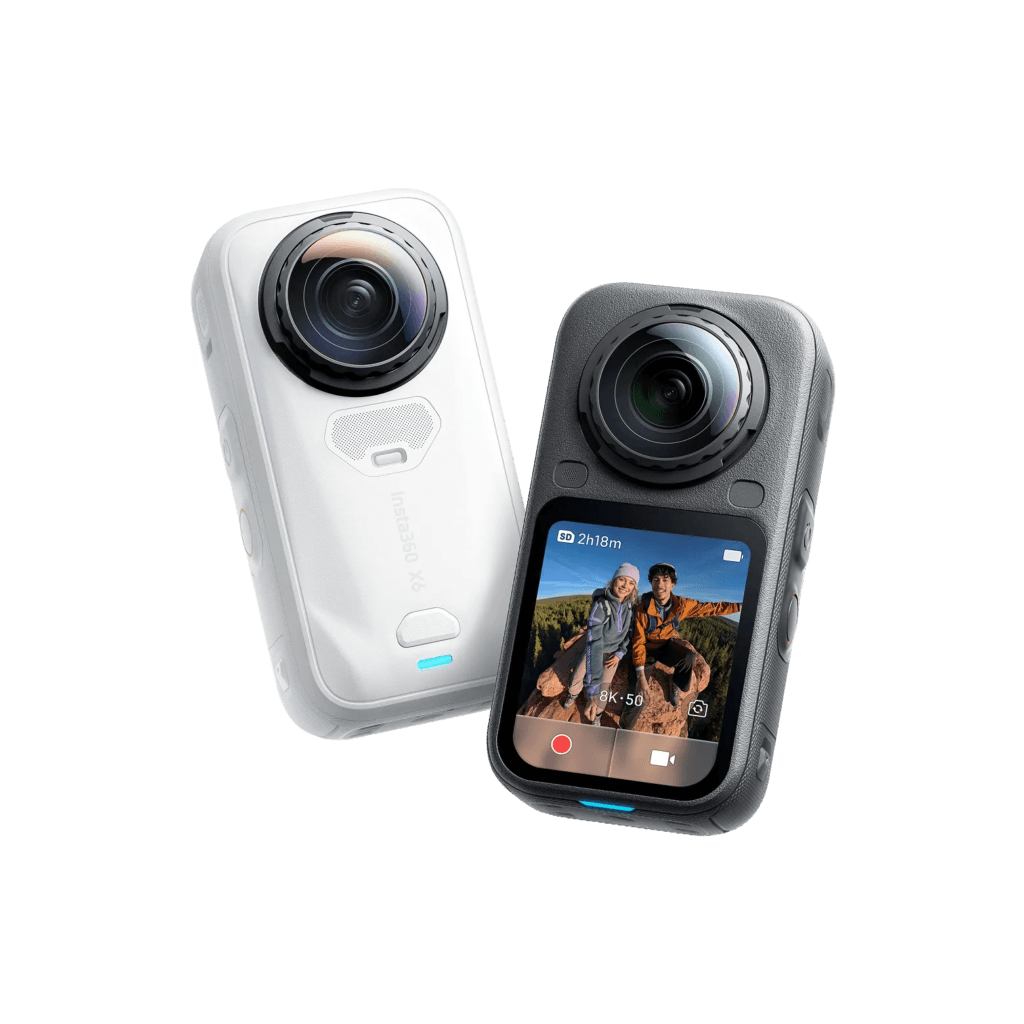
Insta360 X6
Insta360's new-generation 360° action camera — dual large sensors, top-tier stabilization, 8K image quality, and a premium experience that redefines the performance ceiling of 360° shooting.
You shoot in low light or record long sessions
- Night footage — the new 1/1.1″ SONY sensor (~4× the light intake) embarrasses the X5
- 8K endurance jumps from 85 to 140 min, and it survived 8 hours of direct-sun charging-and-recording in my test
- You want first-person POV vlogging — X6-exclusive with the POV Tracker
- 10-bit + Dolby Vision, finally
You shoot mostly daytime and watch the budget
- Best price-to-performance in the lineup now that it's discounted
- Image quality is still above average for a 360 camera — daytime gaps are small
- It's your first 360 camera; the invisible-selfie-stick magic is identical
- Accessories (quick-release mount, 1/4″ thread) carry over to the X6 anyway, so nothing you buy is wasted
Tested over 3 weeks with both cameras: identical walk routes, night streets, and a timed 8K battery + thermal torture test. All footage below is straight out of camera.
Real-World Sample Footage & Photos
Specs come later. Footage first — same scenes, both cameras, no grading. Judge the image quality with your own eyes before any numbers.
X6 Sample Footage & Photos
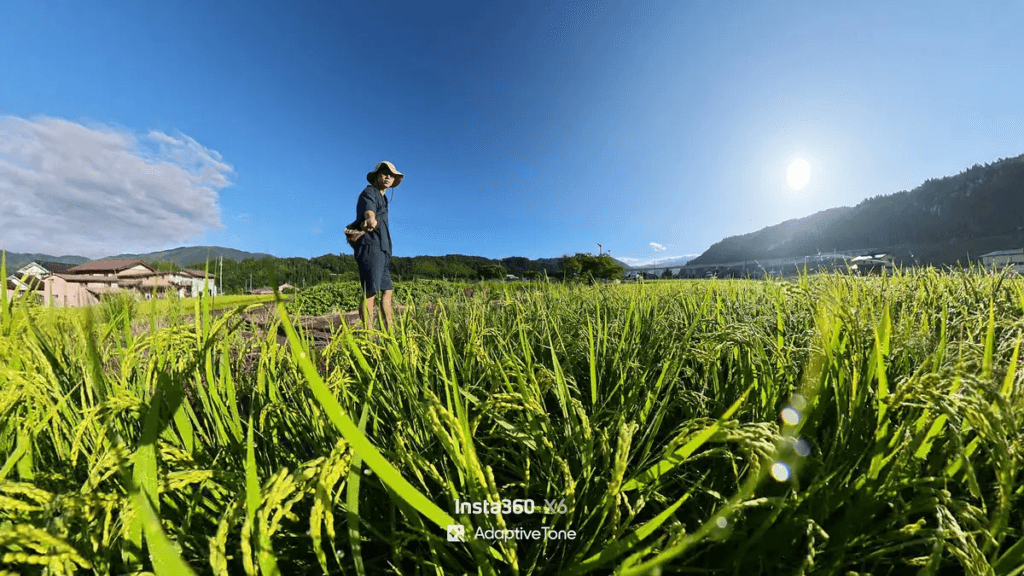
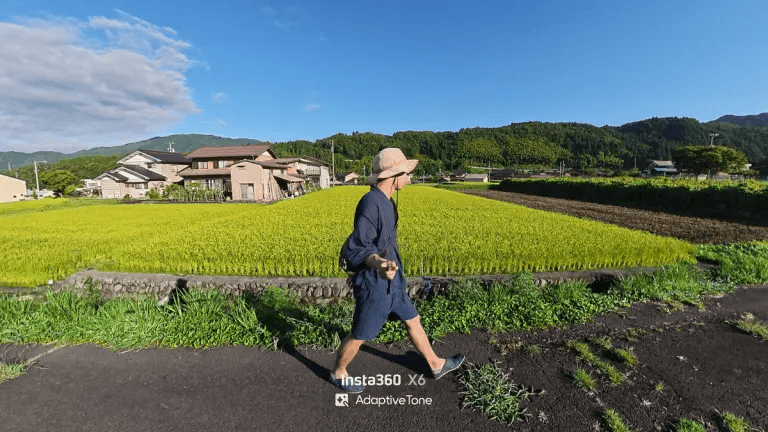
This is what I love about 360 cameras: I was just walking, alone, no plan — and the footage still looks cinematic. The X6's color took the biggest step forward. It's warmer, and much closer to what my eyes actually saw on location.
The reason is the new custom SONY sensor — 1/1.1″, roughly 4× the light intake of the X5's. Detail holds up, and color finally lands where it should. Best-looking 360 camera Insta360 has shipped, in my opinion. The price stings, but you can see exactly where the money went.
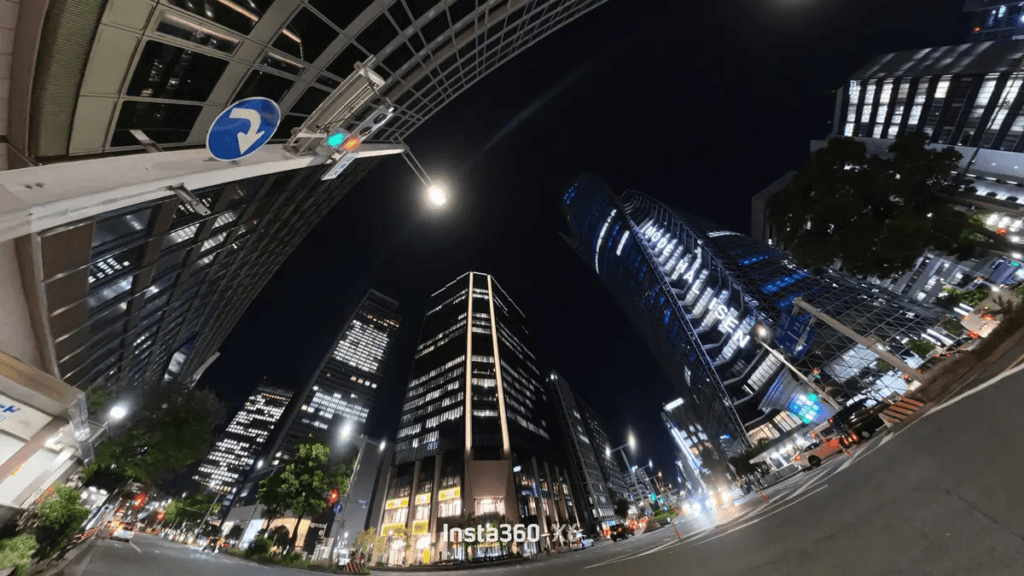
Crop deep into the 360° frame and it still holds up.
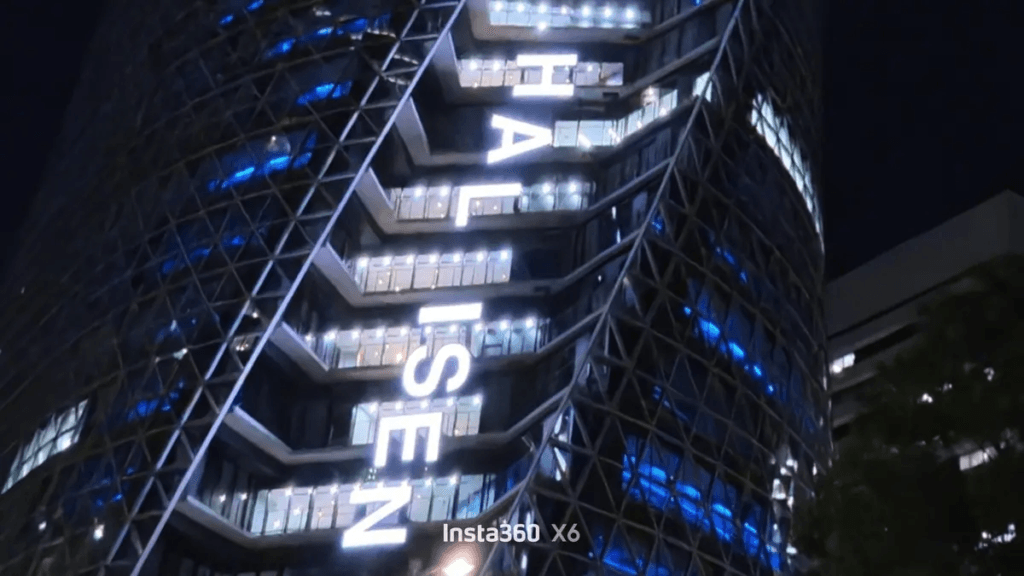
Layered color from the SONY sensor plus 120MP photos means you can crop and reframe hard in post and the detail stays clean. For a 360 camera, that combination feels almost unfair.
To be clear, the X5 didn't get worse — the X6 just raised the ceiling. Once you've seen X6 footage and go back to the X5, the gap is obvious: depth and spatial layering.
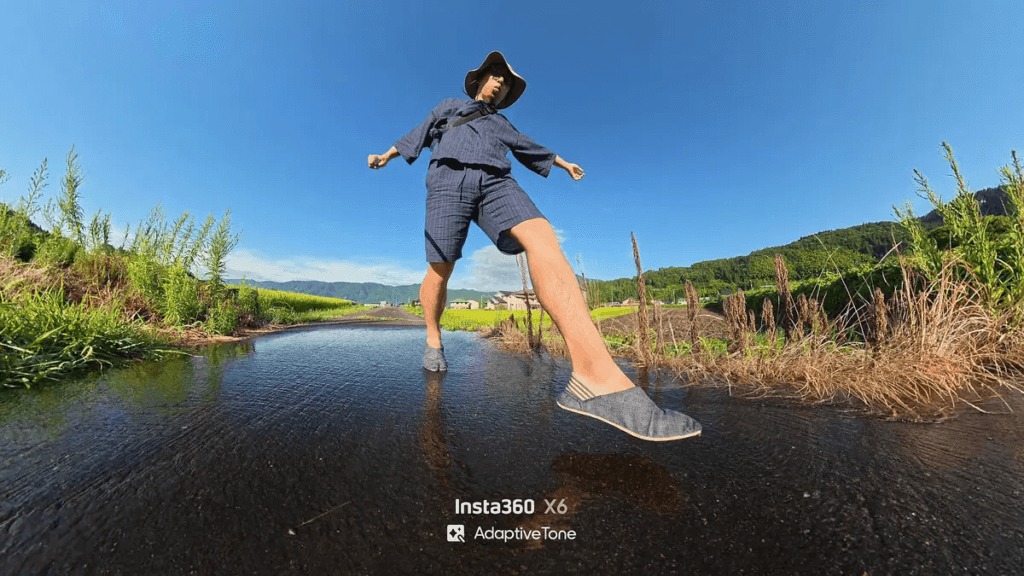
The front-rear lens seam stitches cleaner too — check the tile lines in the shot below.
Shot with a random filter applied, straight out of camera. No grading on this one.
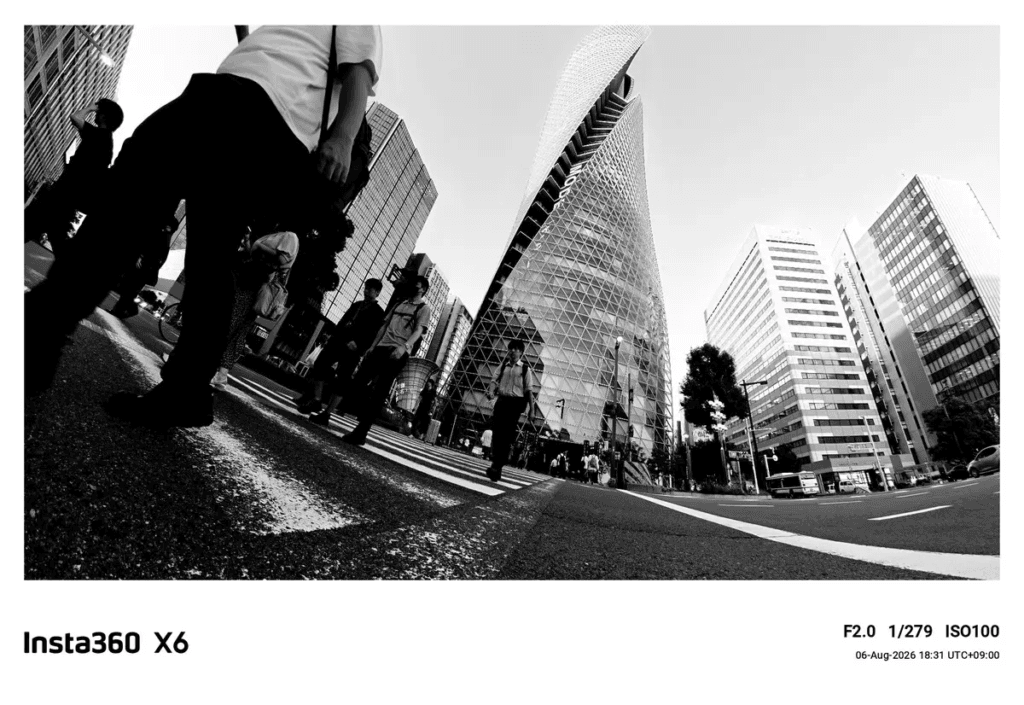
The X6 is Insta360's flagship on every count right now: best image quality, longest battery, and the closest any 360 camera has come to being a daily vlog main camera.
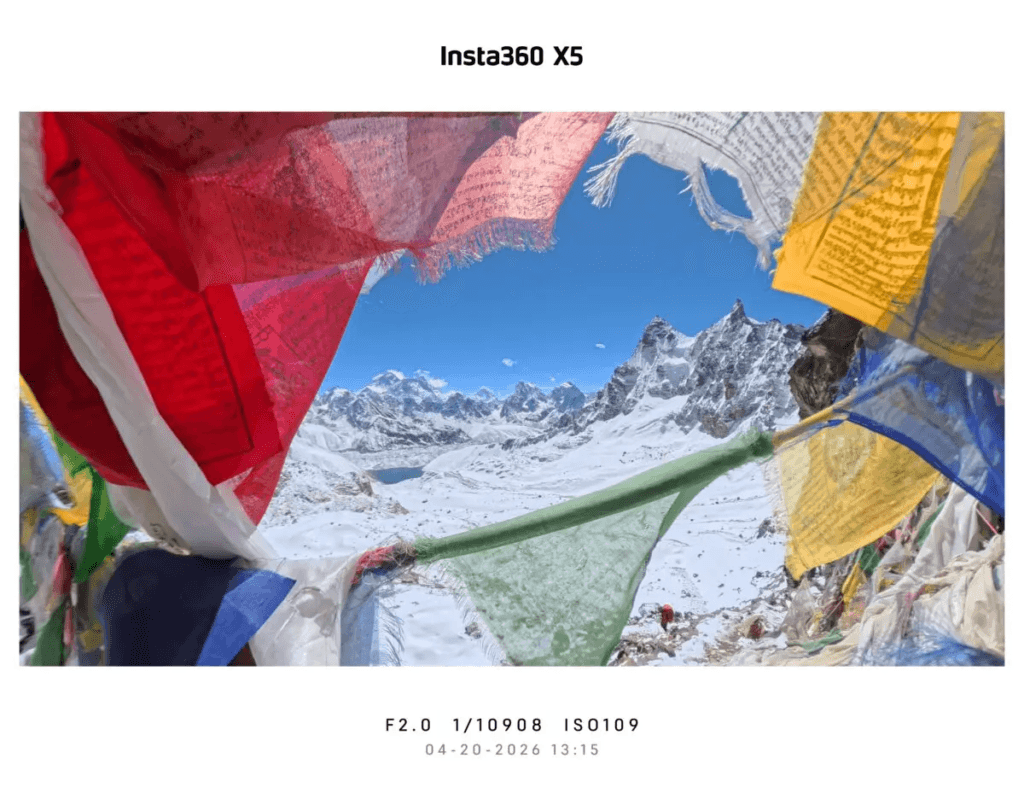
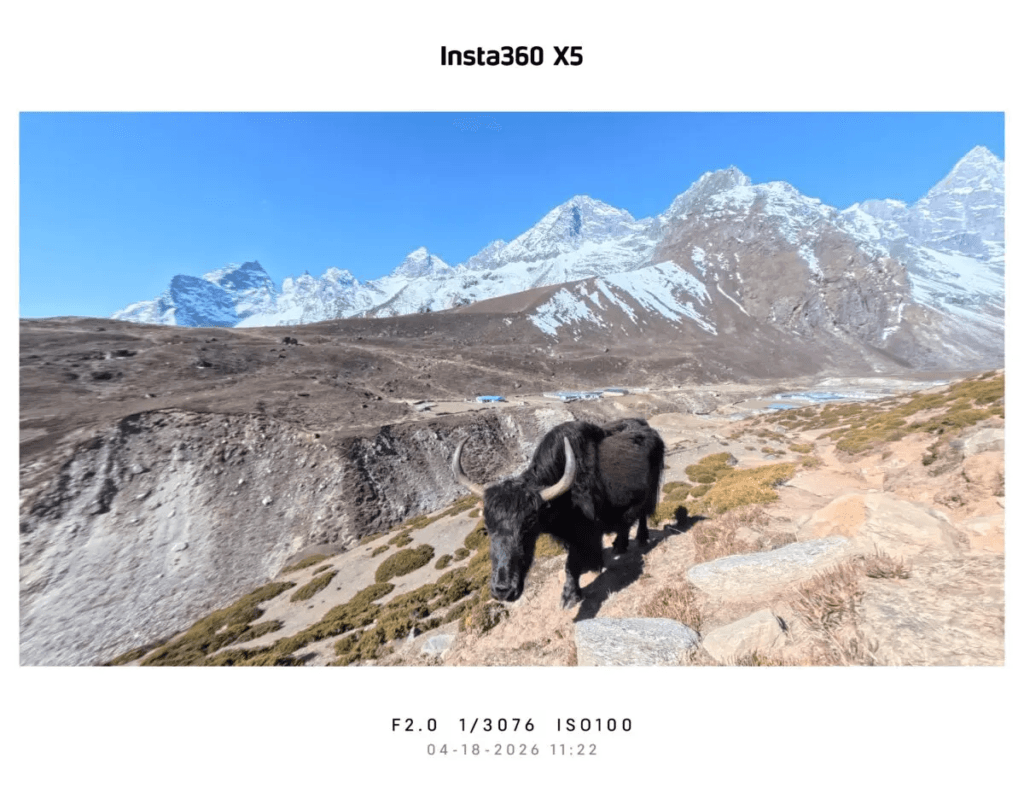
X5 Sample Footage & Photos
Honest take on tone: the X5 is actually more vivid — punchy, social-ready colors straight out of camera. The X6 goes natural and easy on the eyes. That part is a taste call. Resolution and detail are not — side by side, the gap is right there.
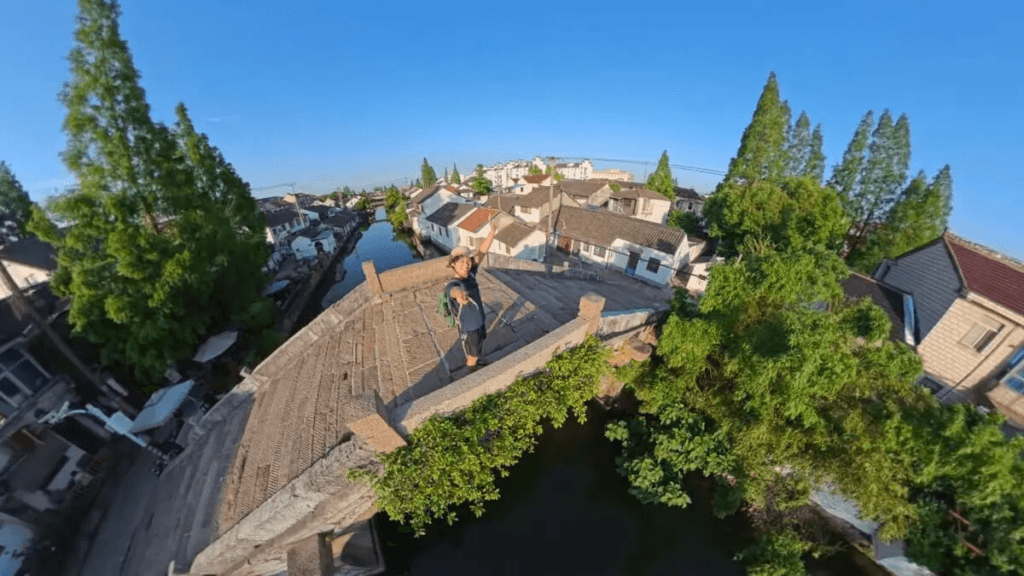
On its own, the X5 looks fine. Next to the X6, detail runs a touch softer and the depth falls just short.
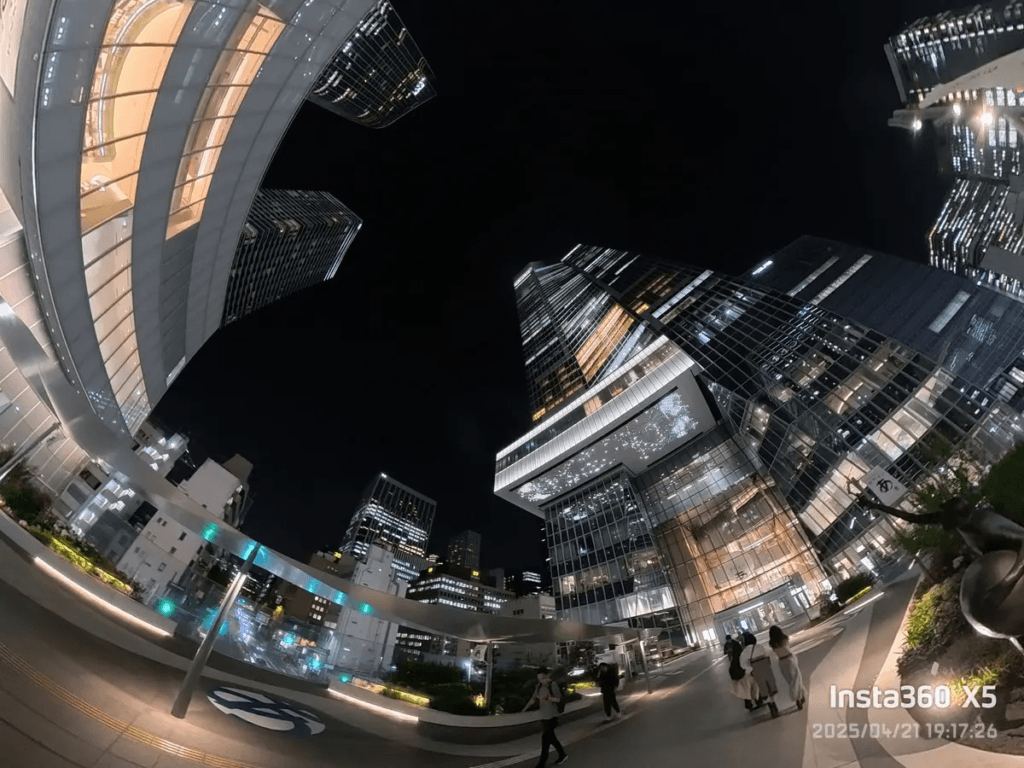
The X6 is edging into digital-camera territory. The X5 sits at “good for a 360 camera” — which it is, night scenes included. But that's exactly the gap, and in single-lens mode it gets wider.
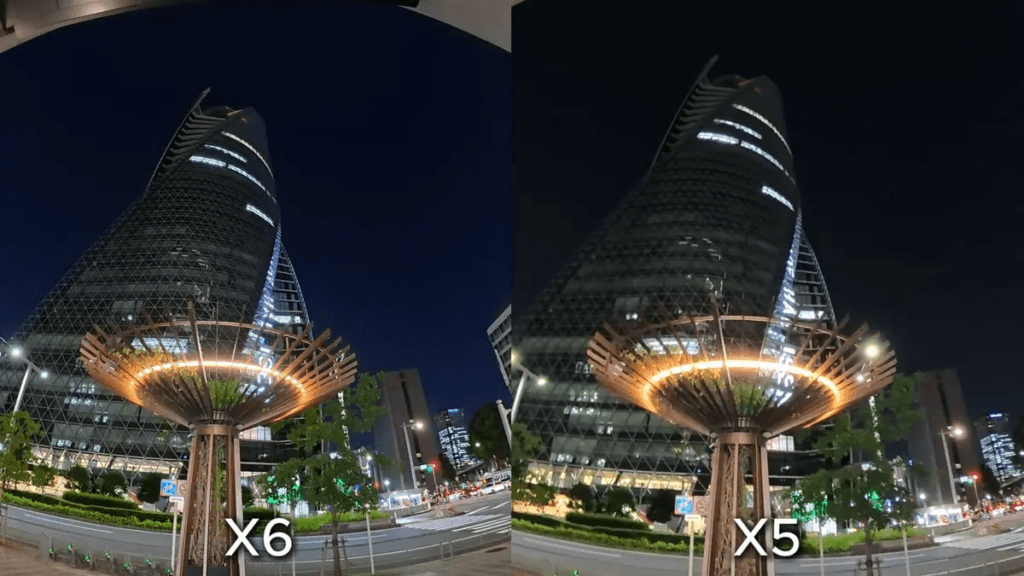
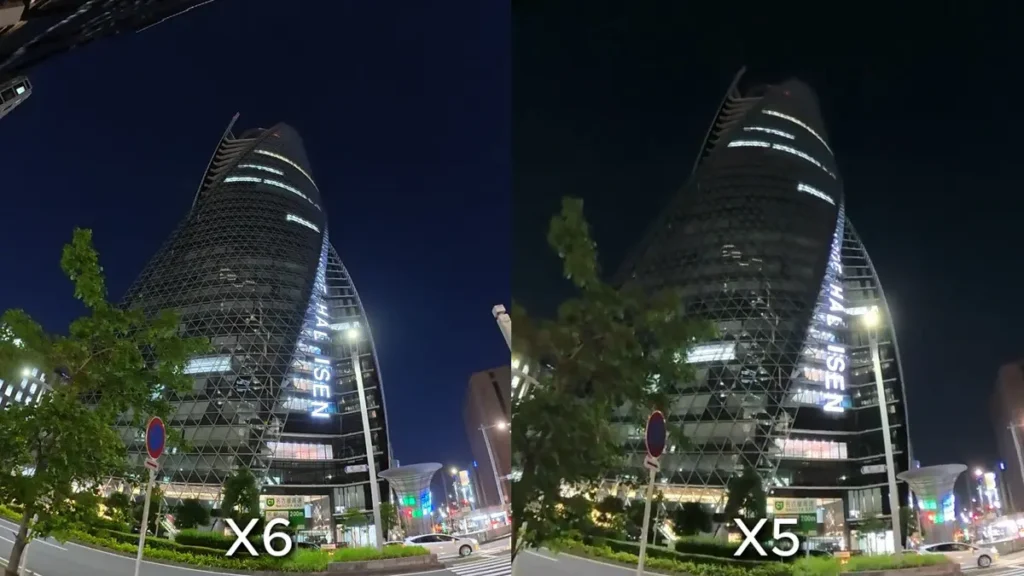
Same scene, both cameras:
Spec Comparison
Spec comparison across three generations: X6, X5, and X4.
| X6 | X5 | X4 | |
|---|---|---|---|
| Standard Bundle Price | NTD $21,700 HKD $5,099 | NTD $14,900 HKD $3,699 | NTD $14,200 HKD $3,399 |
| Sensor Size | 1/1.1″ SONY Sensor | 1/1.28″ | 1/2″ |
| Processor | 3 | 3 | 360 |
| Video Resolution | 8K50fps / 6K60fps / 4K100fps | 8K30fps / 5.7K+30fps / 5.7K60fps | 8K50fps / 5.7K+30fps / 5.7K60fps |
| PureVideo (Low Light) | — | Single-lens 5K60fps | Single-lens 4K60fps |
| Photo Resolution | 120MP | 72MP | 72MP |
| Battery Capacity | 2600mAh | 2400mAh | 2290mAh |
| 8K Recording Time | 140 min | 85 min | 75 min |
| Fast Charging | ✓ | — | — |
| Waterproof Depth | 20m | 15m | 10m |
| Microphone Wind Guard | ✓ (full body) | ✓ | — |
| Weight | 196.5g | 200g | 203g |
| Lens Protection | Reinforced lens | — | — |
| Interchangeable Lens | — | — | — |
| Mount Spec | Quick-release mount / 1/4″ thread | Quick-release mount / 1/4″ thread | 1/4″ thread |
What actually changed from X5 to X6:
- Larger sensor — now a custom SONY unit
- 8K 50fps high-frame-rate recording — motion blur and stutter are gone
- Longer battery life (details in the battery section below)
- Slightly lighter, shorter body
- A noticeably higher price tag
New on the X6:
- AI smart audio
- POV recording mode (with the POV Tracker accessory)
- 10-bit recording (Dolby Vision) — richer color gradation, far more grading flexibility
The X6 launches at NTD $21,700 / HKD $5,099. Yes, it's expensive — but the footage justifies it. Every meaningful spec moved forward at once, which is rare for a generational refresh.
Design & Hardware
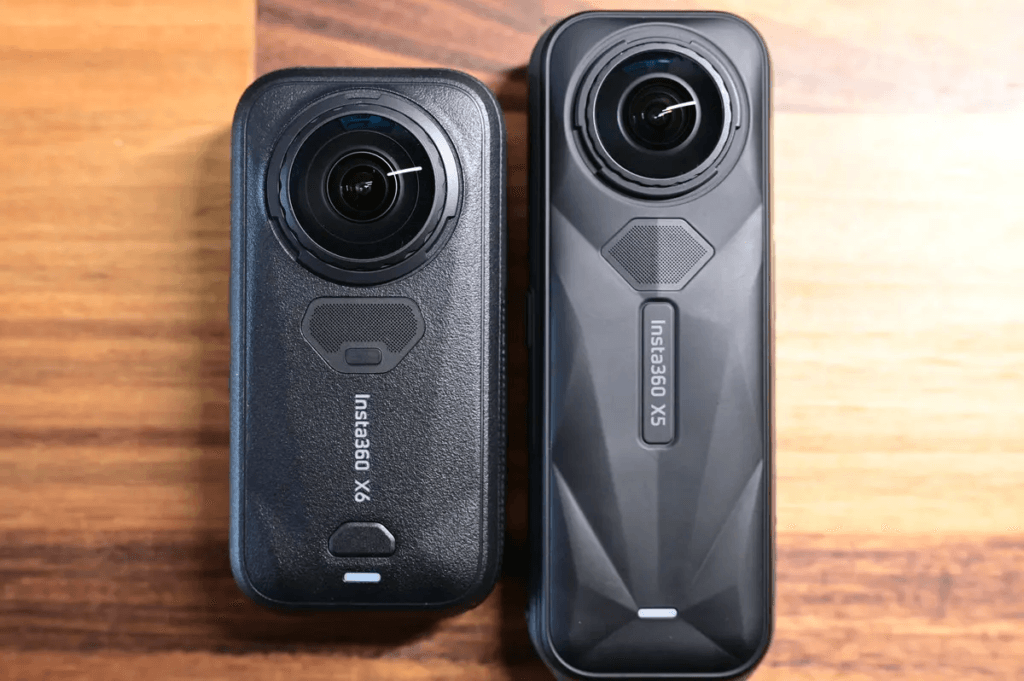
The X6 is shorter than the X5 but a touch wider, and the larger sensor pushed the lens diameter up by about 2mm.
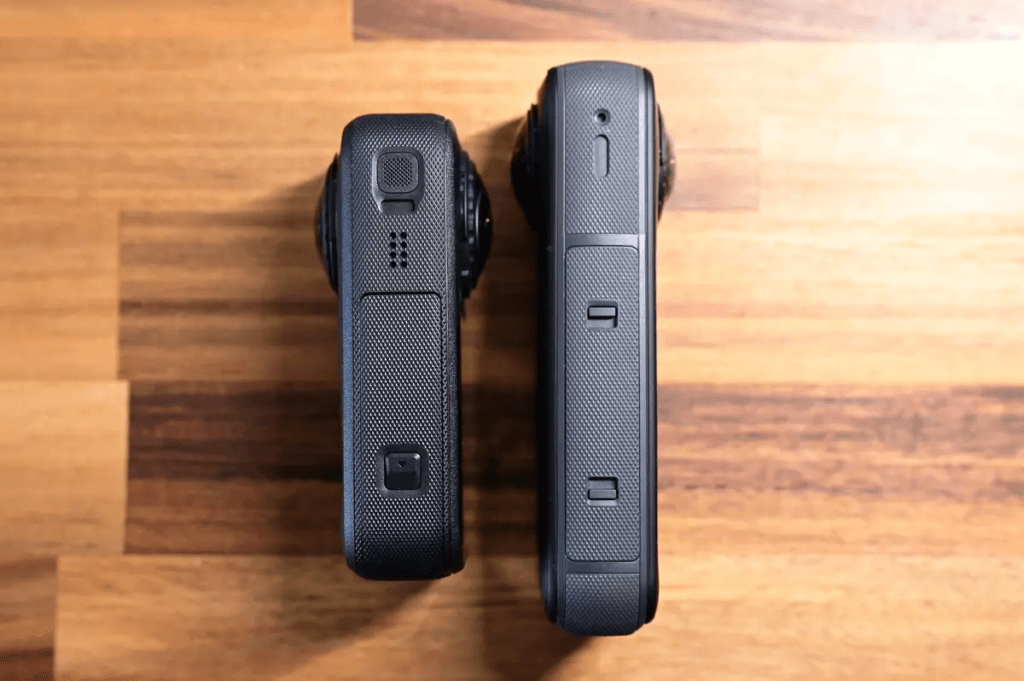
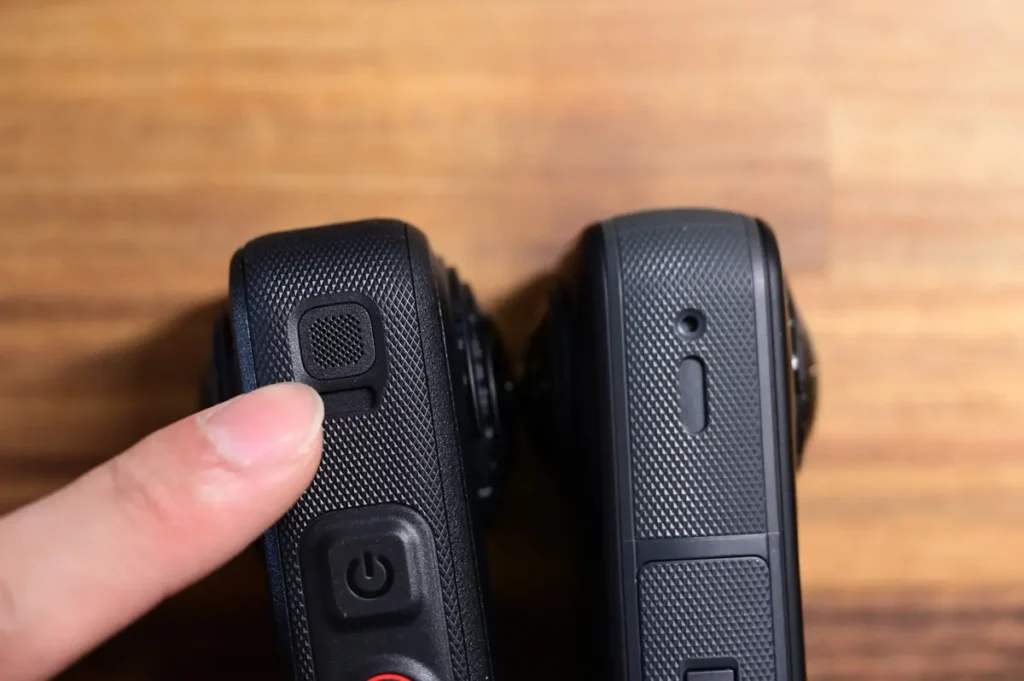
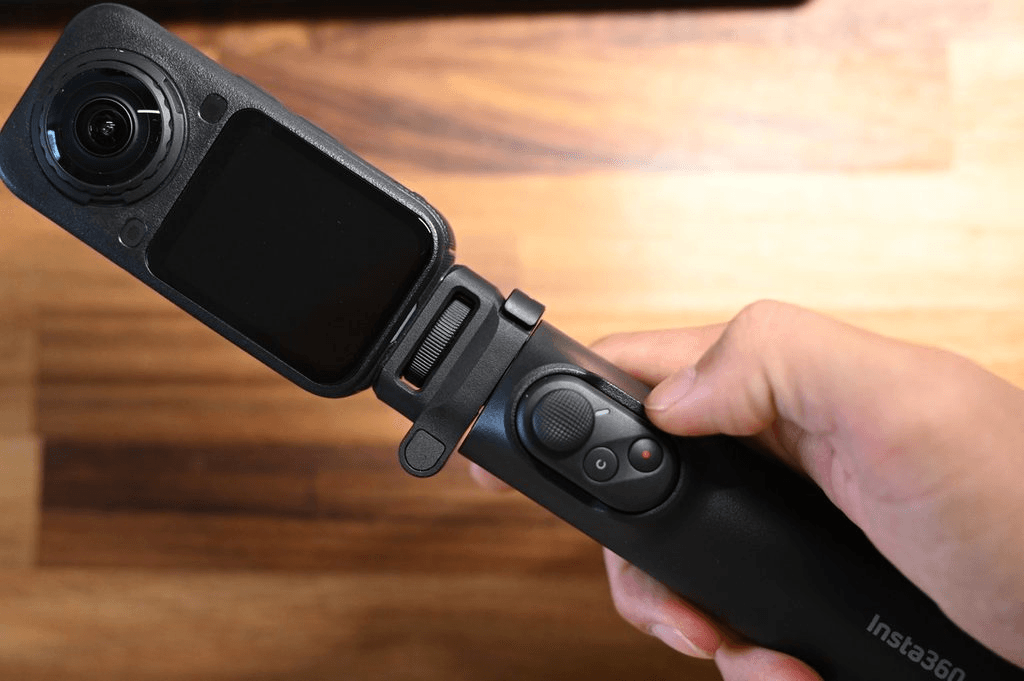
From the side you can see the button rethink: the record button moves from the front to the lower right side of the body.
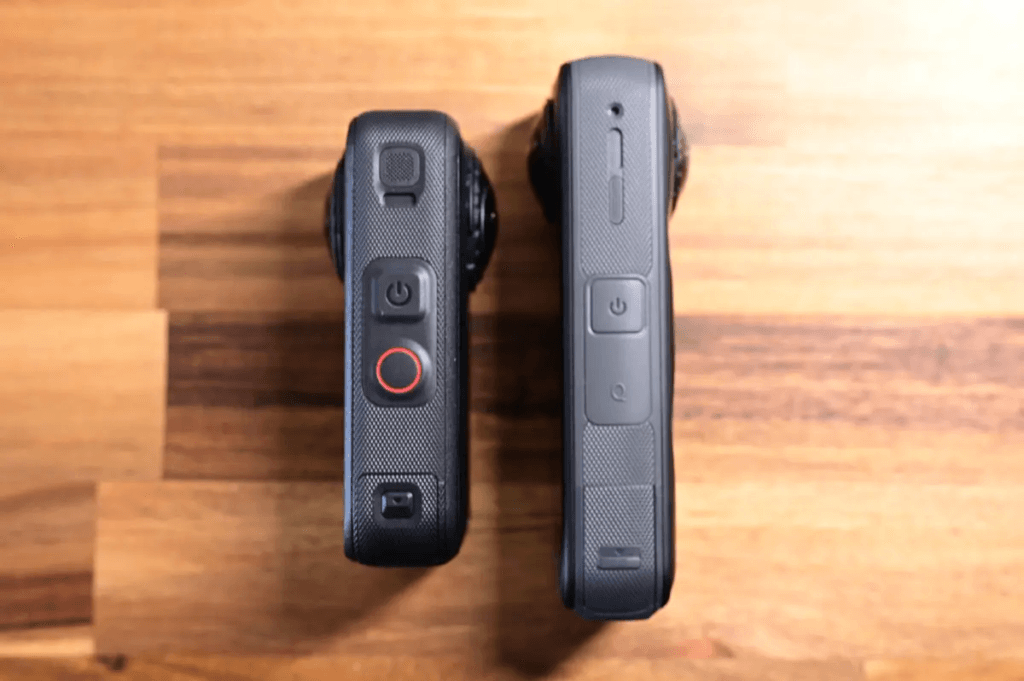
The quick and menu buttons are consolidated onto the front, also sitting lower.
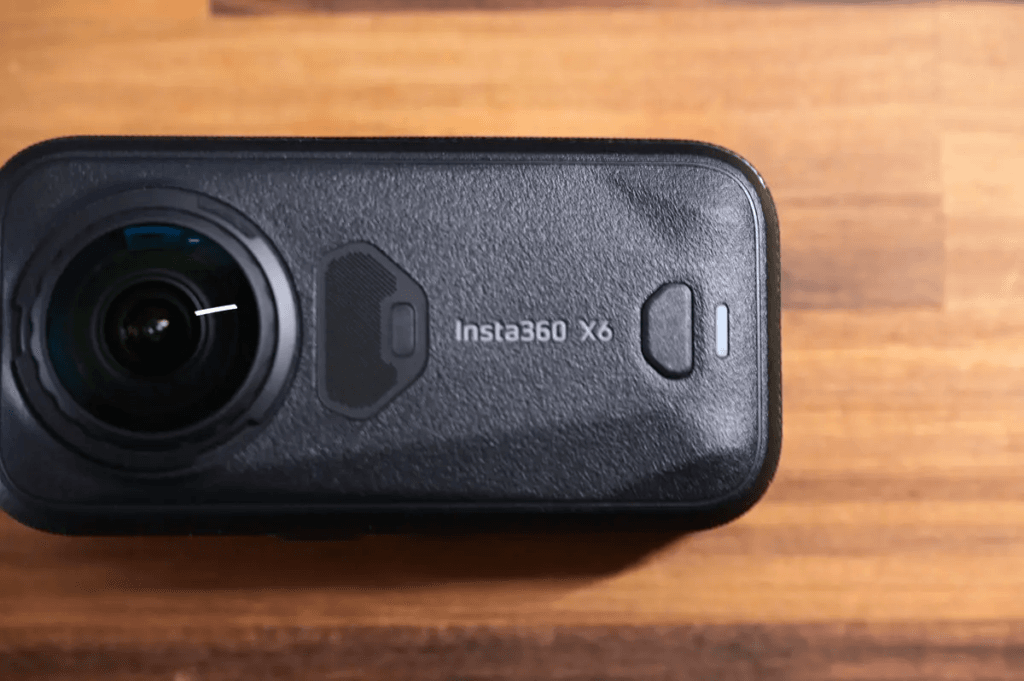
No buttons were removed — it's a rearrangement, not a reduction, and the layout makes more sense in hand. The smart start features from the X5 (twist-to-record, gesture control, voice control) all carry over.
Weight & Size Changes
The X6 weighs 196.5g — about 4g lighter than the X5 on the scale.
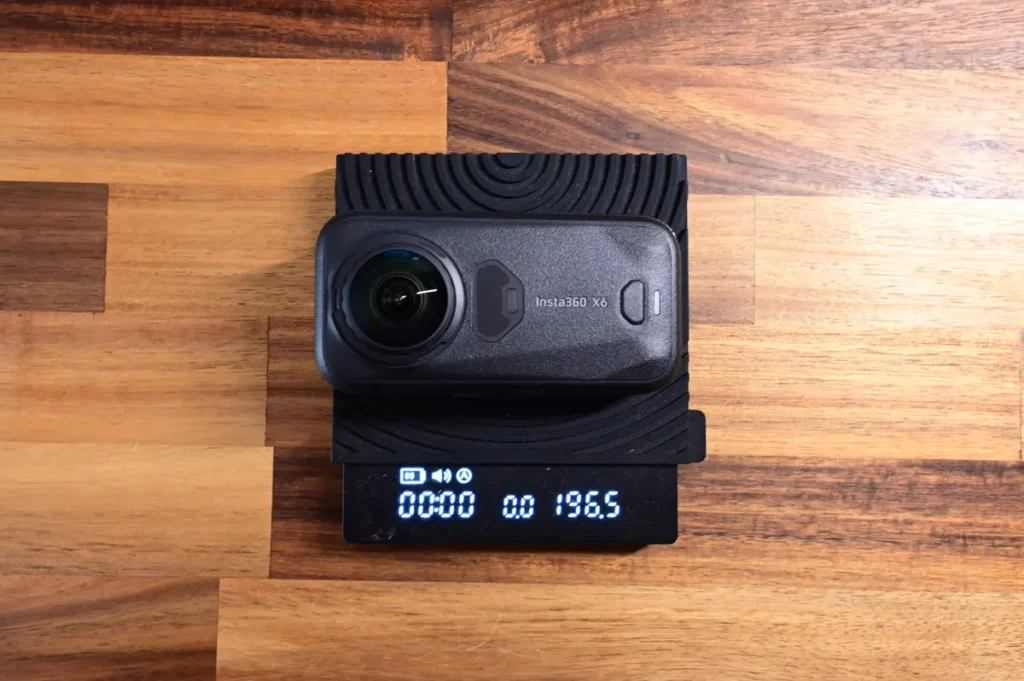
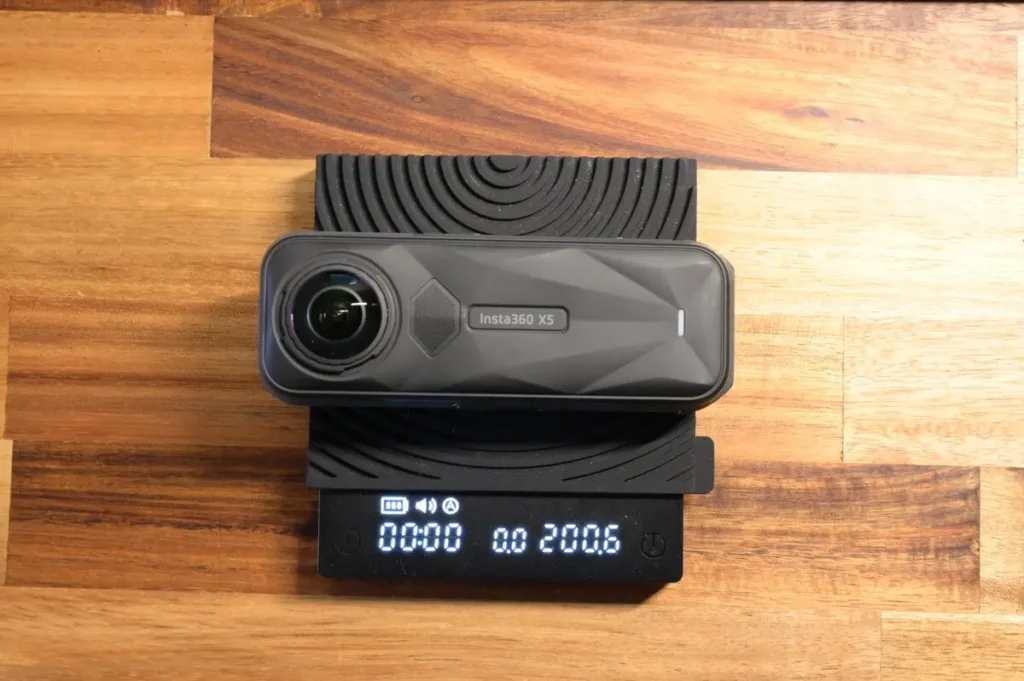
| X6 | X5 | X4 | |
|---|---|---|---|
| Body Weight | 196.5g | 200g | 203g |
Insta360 didn't fatten the body to stack specs — the body has been trimmed steadily since the X4, and by the X6 the shape has basically settled. Handling-wise, I actually find the X5's longer body more comfortable to hold and operate. But most people shoot a 360 camera on a selfie stick anyway, so grip ergonomics matter less than weight — and lighter is what users feel every single day.
- The X6 is shorter but still comfortable to hand-hold
- The X5 is easier to grip and operate one-handed
The X6 gets smaller and lighter while keeping the X5's overall shape — a balanced compromise. It still stands upright, and picking it up feels as natural as picking up a phone.
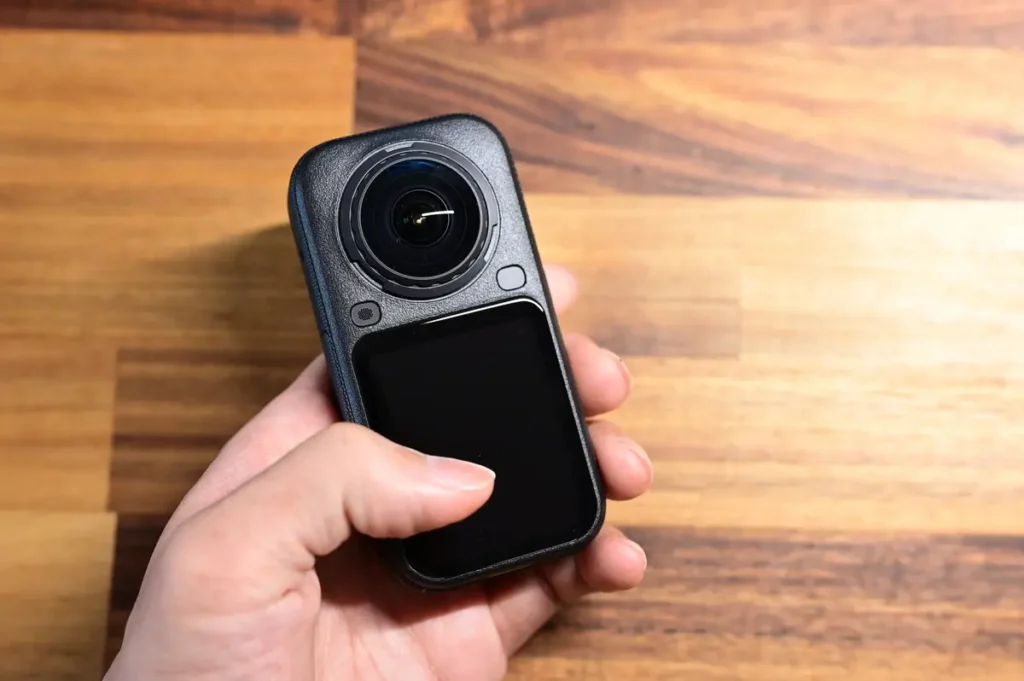
Microphone Wind Guard
The X5 already had a wind guard; the X6 extends it across the entire body. Insta360's wind-noise handling has always been a strength, and the X6 keeps that standard.
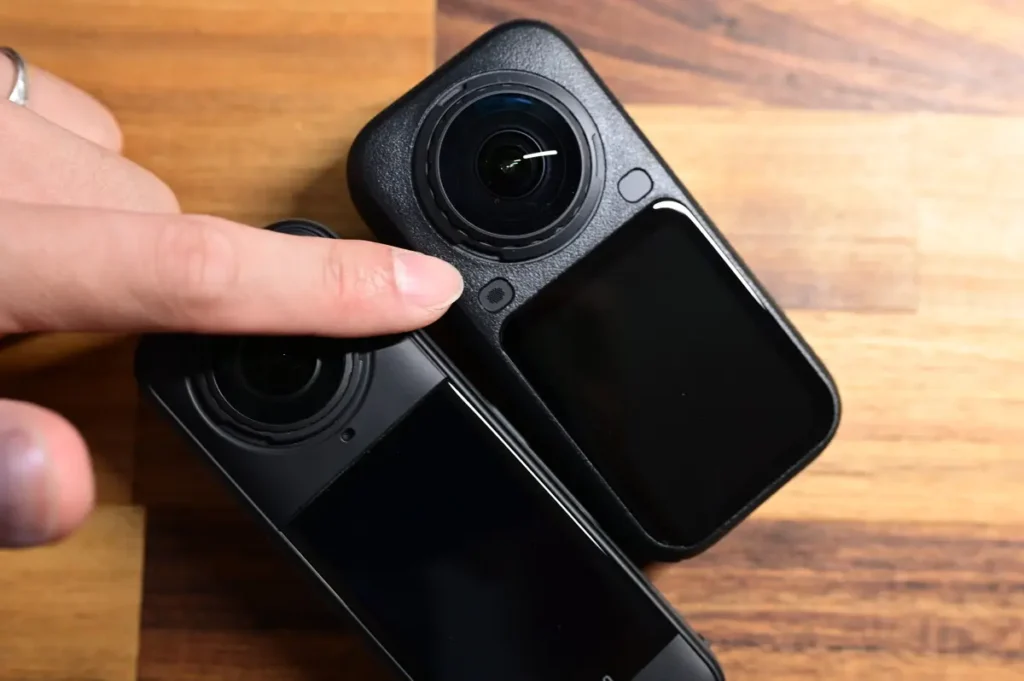
Mount Spec Unchanged
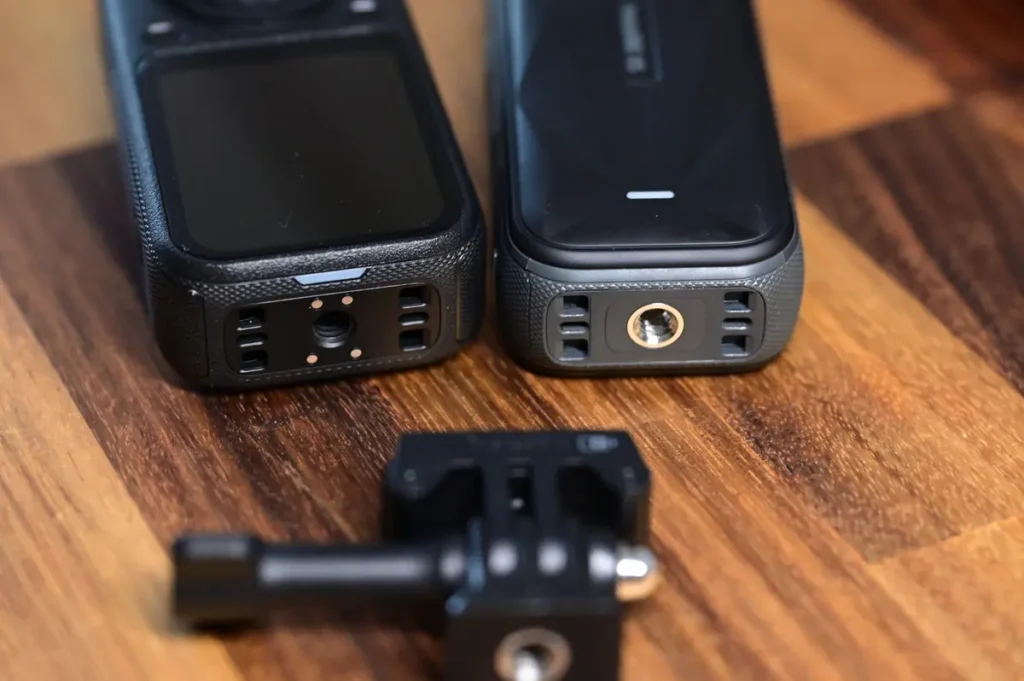
The X6 keeps the 1/4" thread + quick-release mount, unchanged. It's cross-compatible with the X5, Ace Pro 2, and other Insta360 gear — existing accessories carry straight over. If you're upgrading from an X5, that's real money saved.
Screen Size Change
The X6 gets a next-generation screen — a 2.32" OLED touchscreen, up from the X5's 2.29" LCD. Clearer and easier to read in daylight.
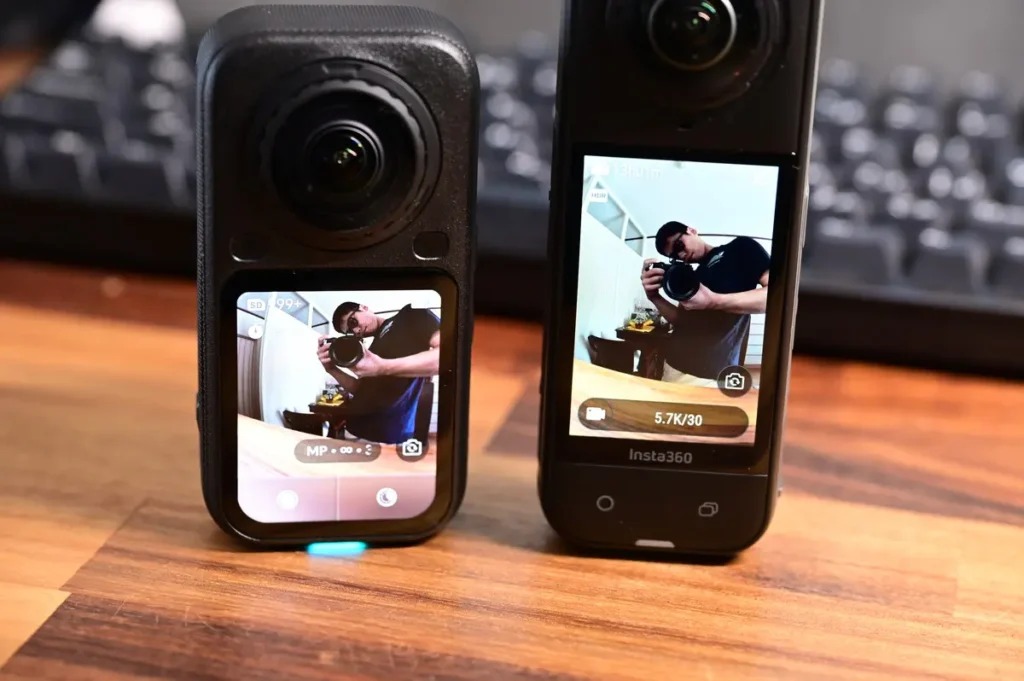
Touch response on 360 cameras has been smooth since the X3, and the X6 clears that bar easily. (Battery and endurance get their own full section below.)
Image Quality Differences
Image quality is where the X6 earns its price.
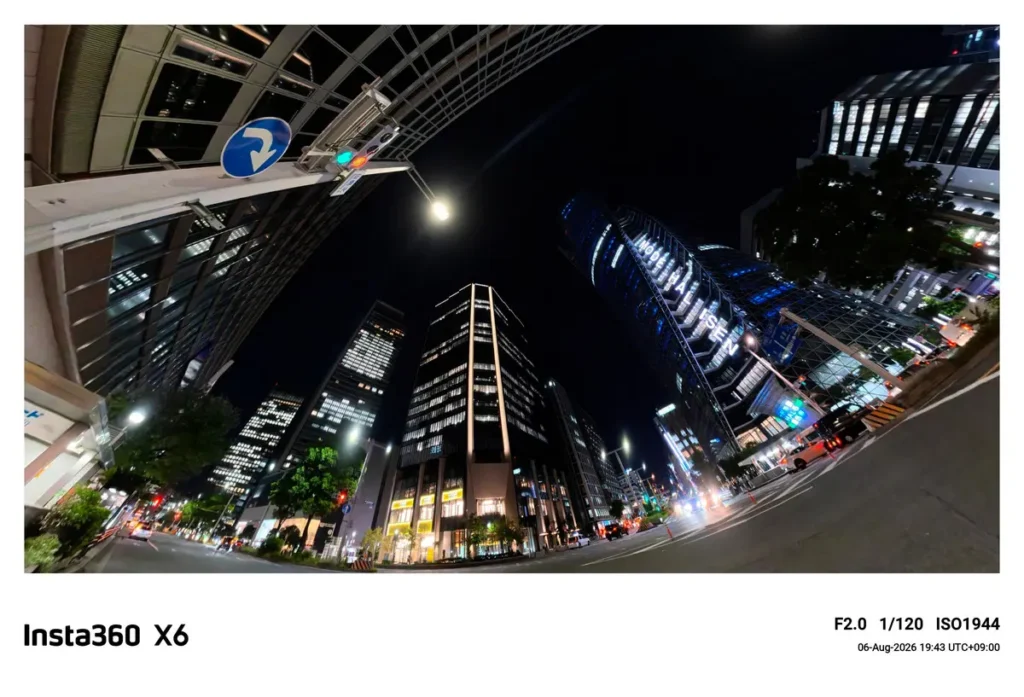
Daytime colors are very natural — honestly, this tone reminds me of GoPro at its best.
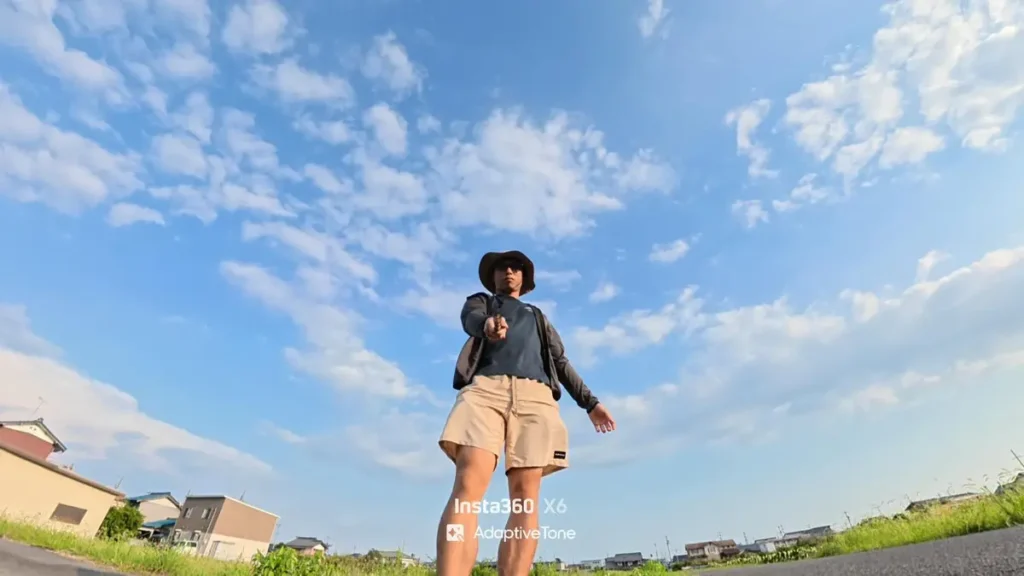
I've always liked GoPro's color science, so the X6 leaning that direction suits me perfectly. You won't notice it from a single shot — the fastest way to see it is next to the X5.
vs X5 (Daytime Tone)
In bright sun, image quality between the two is closer than you'd expect — sensor size shows its value mainly in low light.
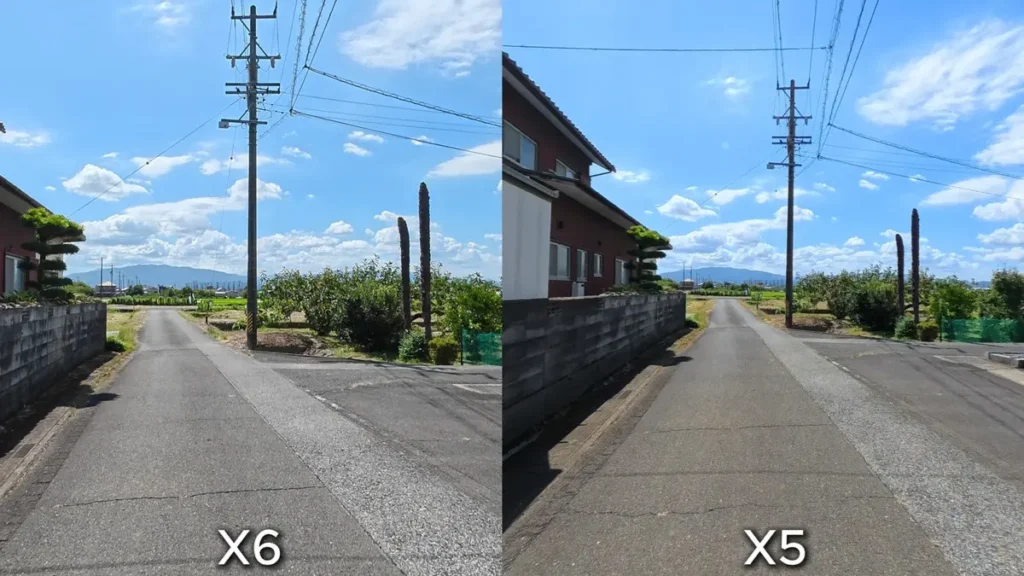
But the tone genuinely changed this generation. The X5 shoots high-contrast, vivid, crisp; the X6 goes soft and natural. My first reaction to X6 footage was: this color is very GoPro.
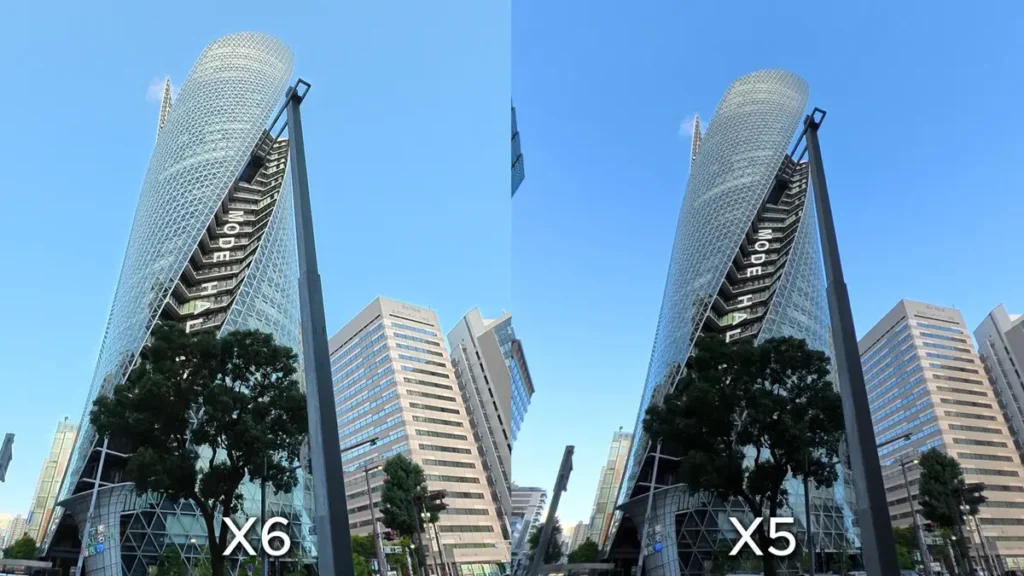
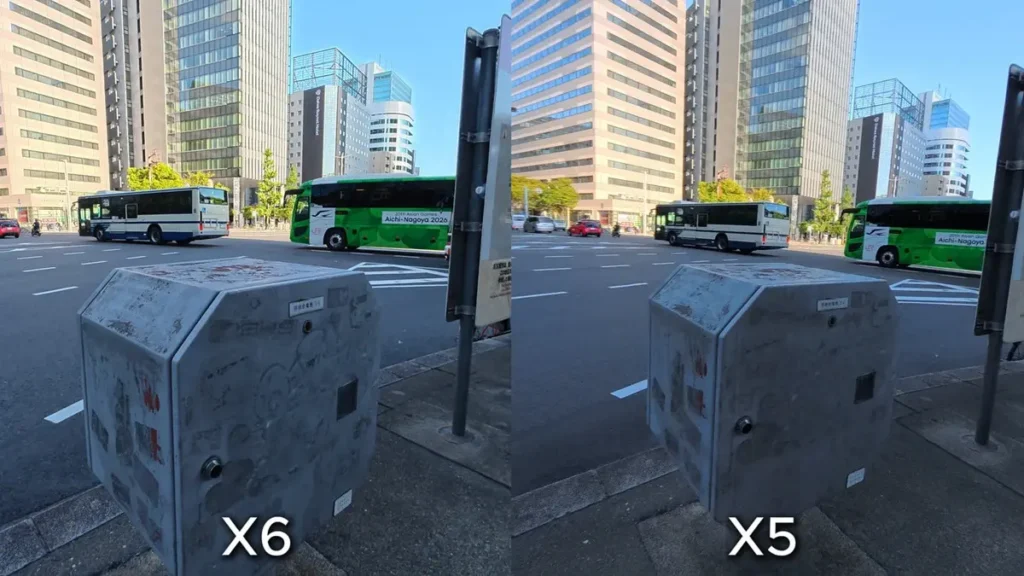
Daytime tone is taste; detail is not. Even random roadside graffiti comes out cleaner on the X6, and tile textures stay sharp line by line.
Low-Light Image Quality
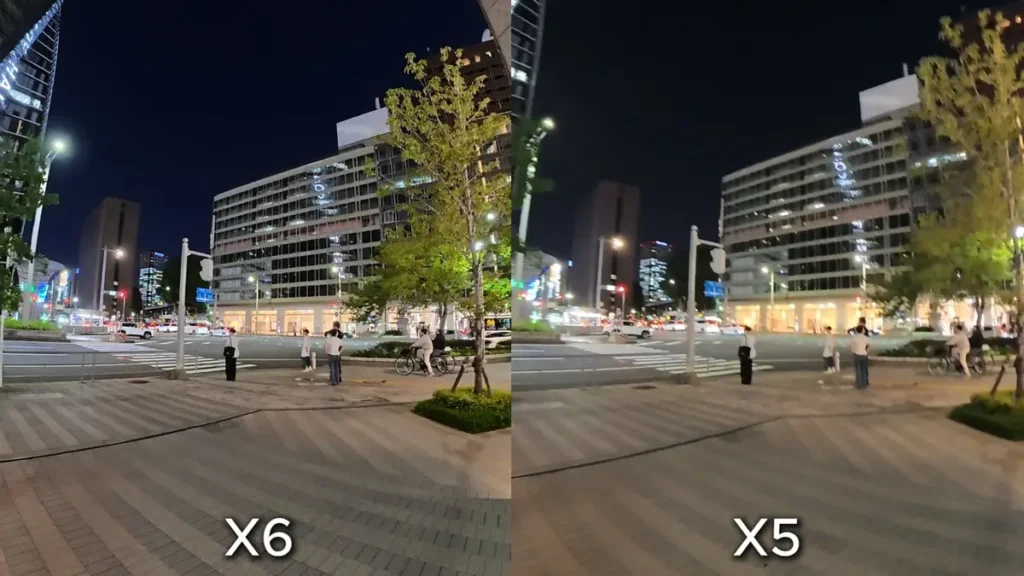
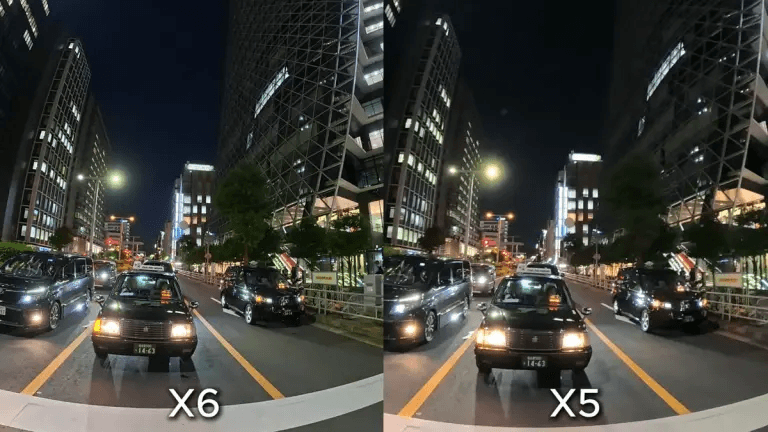
I already liked the X5's night footage — then the X6 jumped another level. In night scenes, the difference is a full tier, not a rounding error.
While walking, the image smears less and flickers less — and the X6 holds that stability the whole way through.
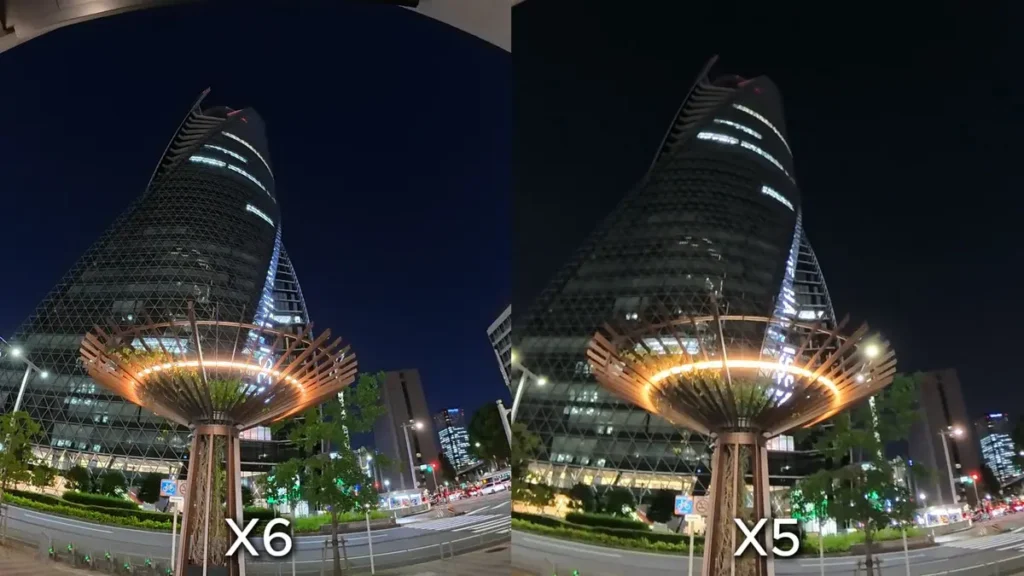
Less noise, blacks that go truly black, lights that actually glow — the glossy feel of a city night is all there. The X5 is pretty at night too, but side by side the X6 shows visibly less color cast.

Filter Changes
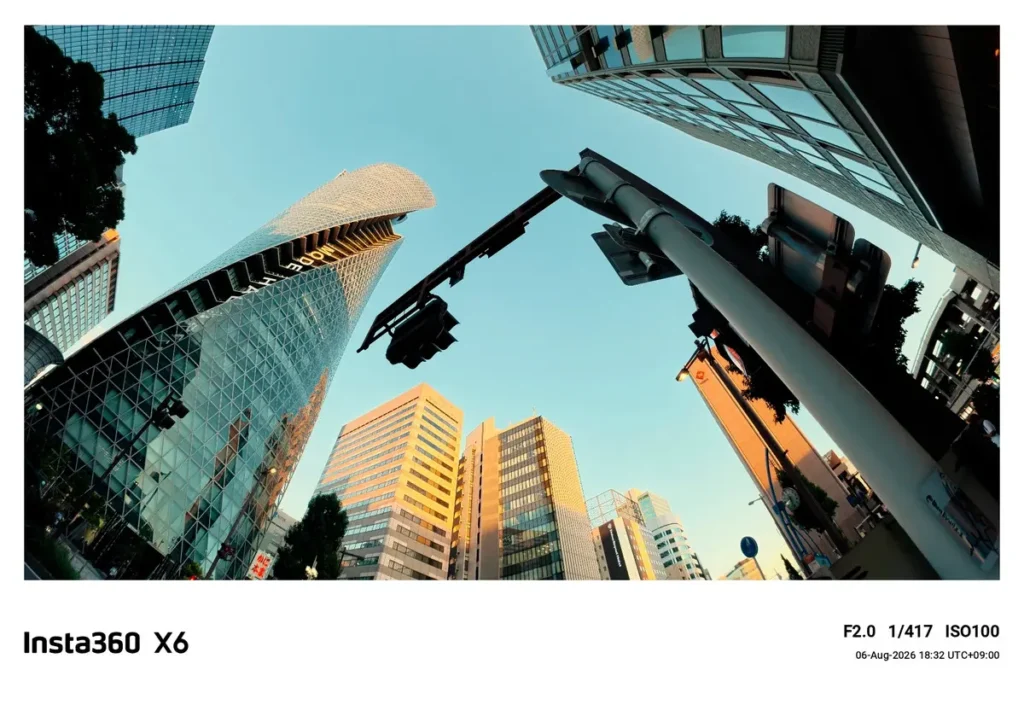
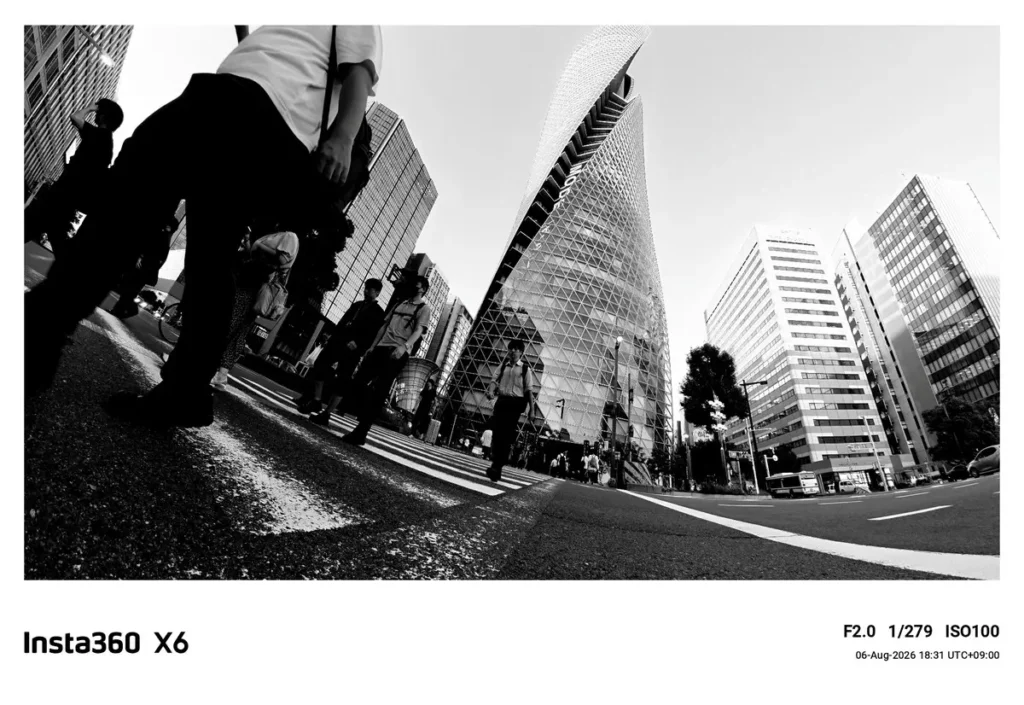
Both cameras offer roughly the same filter lineup, and the X5 can add new filters via firmware update. Insta360's filters lean film-camera — that "atmospheric" look. The NC filter gives a retro feel; the CC filter flatters portraits. But if accurate color is what you're after, the X6's straight-out-of-camera result still beats the X5.
Dolby Vision (10-bit Recording)
The X6 finally supports 10-bit recording, split into standard 10-bit (Log) and Dolby Vision. Standard mode is 10-bit by default, by the way. Log mode gives the familiar flat, washed-out profile you grade later.
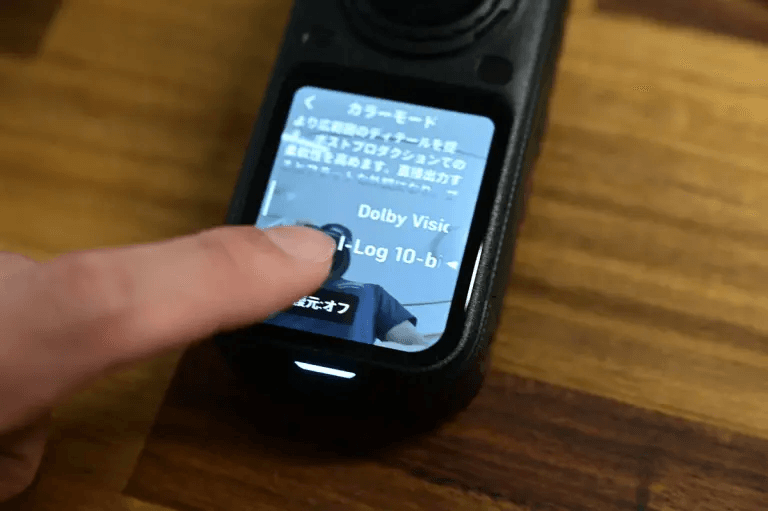
Grading Log properly needs pro software like Adobe's — Insta360's own app and desktop suite can't handle it yet. So most casual users can ignore Log entirely. The other option is Dolby Vision: no editing required, full 10-bit color depth, HDR-grade punch straight out of camera.
Dolby Vision is, technically, an HDR color standard — turn it on and the image gets that "Dolby Vision look." To my eye it reads less like HDR pop and more like color closer to what nature actually looked like. Either way, it refreshes the whole tone, and shooting it alongside standard mode is genuinely fun.
| X6 | X5 | |
|---|---|---|
| 10-bit | ✓ | 8-bit |
| Log Recording | ✓ | — |
| Dolby Vision | ✓ | — |
POV Recording
Something the X5 simply couldn't do, the X6 can: true first-person POV recording via a dedicated accessory.
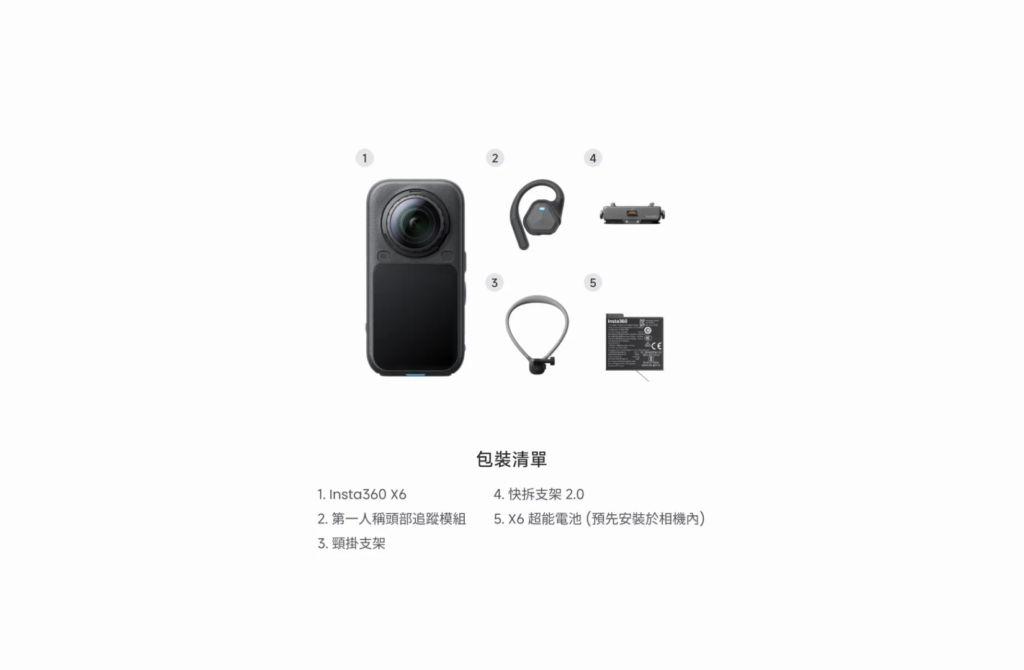
POV means Point of View — first-person perspective, footage that shows what your eyes see. A typical wide-angle action camera gets there with a chest mount. The X6, paired with the first-person head-tracking module, switches to single-lens mode and shoots stable, smooth POV footage like a wide-angle action cam.
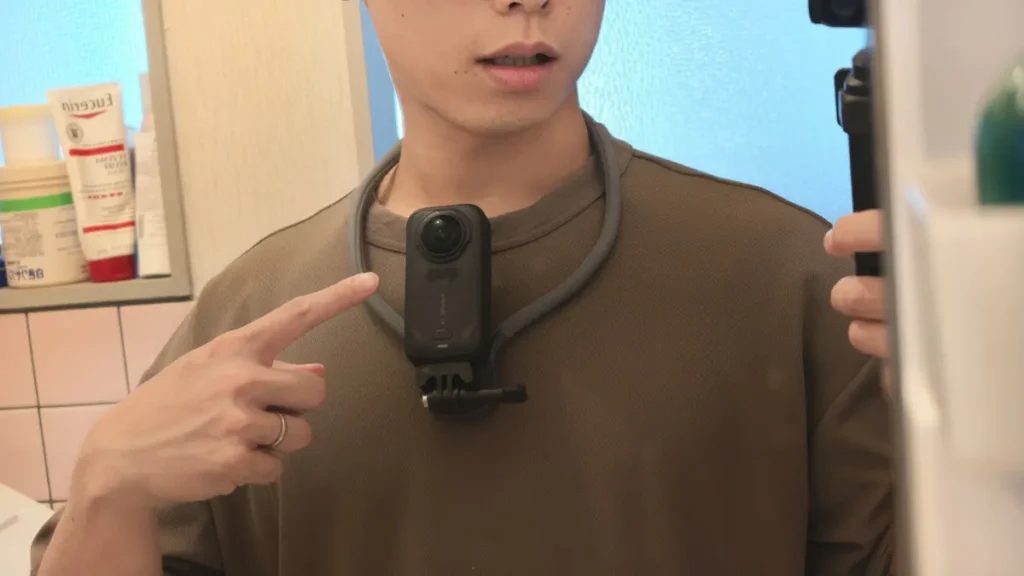
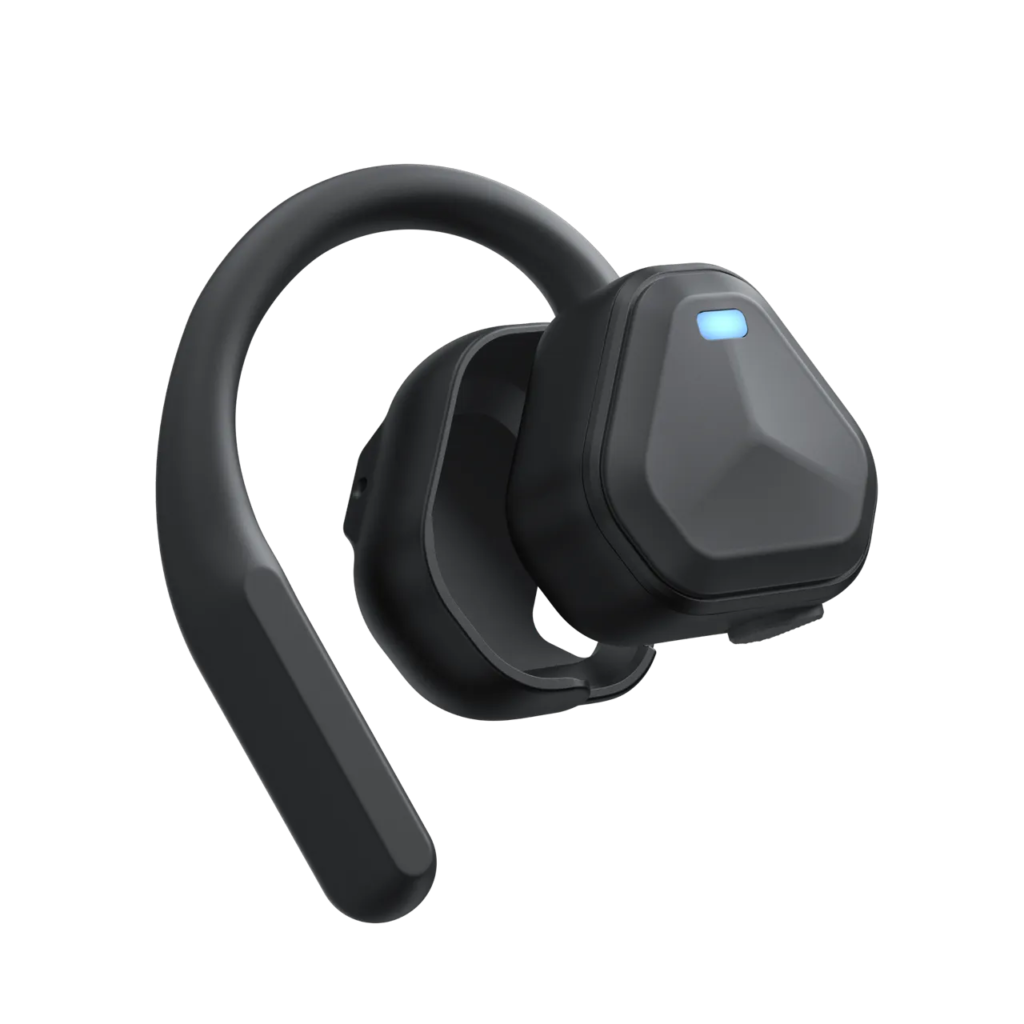
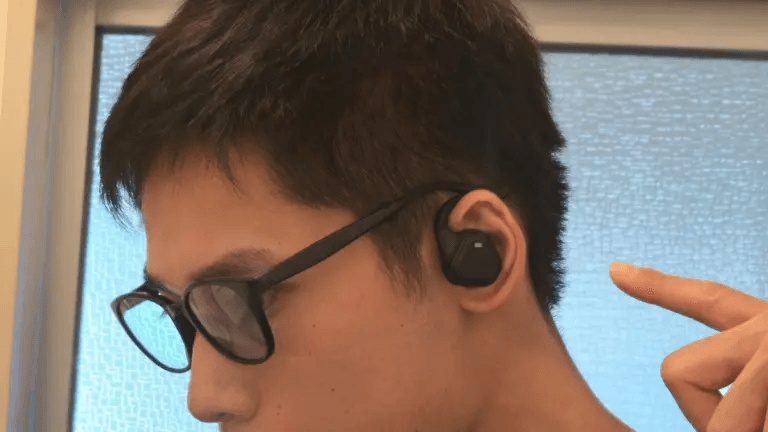
With this accessory, the X6's lens follows your gaze. Look down at the puppy by your feet, the frame goes down. Look up to where the dog ran, it goes up — down uses the lower half of the lens, up uses the upper half. That's the concept.
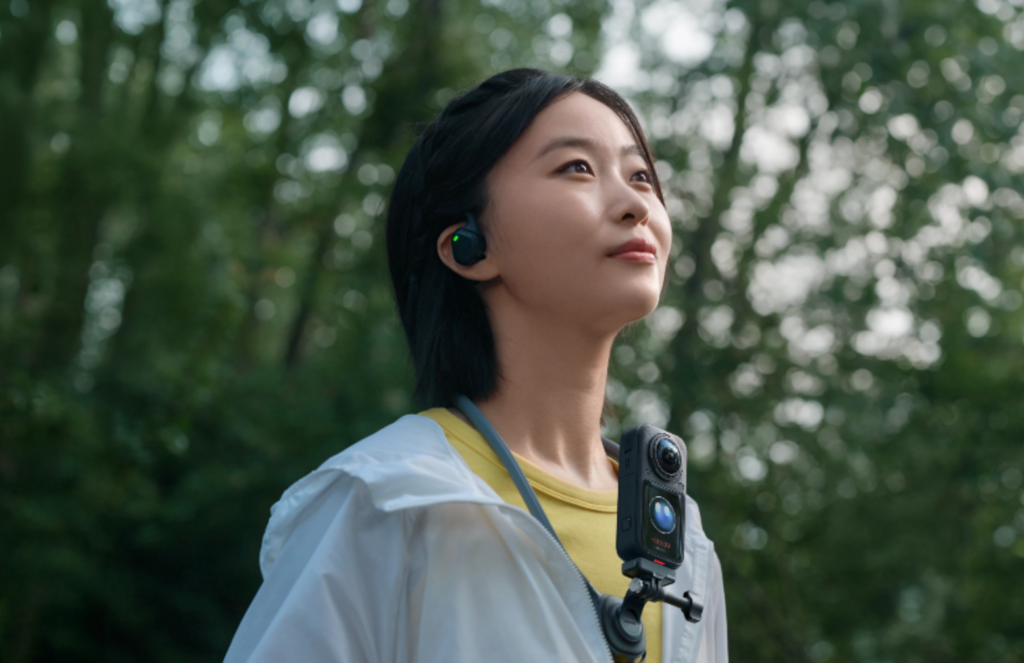
The camera hangs on your neck, but the footage looks head-mounted — wherever you look is where the frame points. It doesn't use one fixed lens; it grabs the half of the frame matching your gaze in real time from the front and rear lenses and stitches them. Right now, only the Insta360 X6 can do this.
| X6 | X5 | |
|---|---|---|
| POV Mode | ✓ | — |
Specs and image quality aside, I think the POV kit is the X6's single most important upgrade. It turns the 360 camera from "just a 360 camera" into a machine you can actually run a daily vlog on. If you were torn between a 360 camera and the GO Ultra, this kit collapses that either/or into one purchase.
InstaFrame Gimbal Mode 2.0
InstaFrame 2.0
Double-tap a person or subject on screen and the camera follows them — classic tracking mode. The problem on 360 cameras has always been distortion: track-mode footage straight off the sensor looks warped.
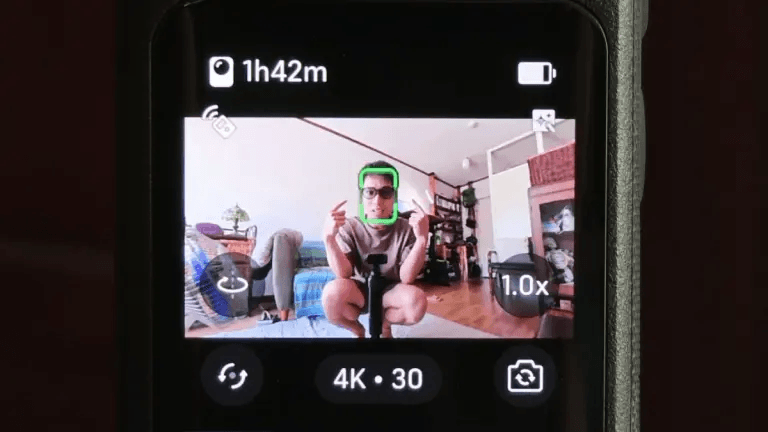
That's the raw footage — unusable as-is.
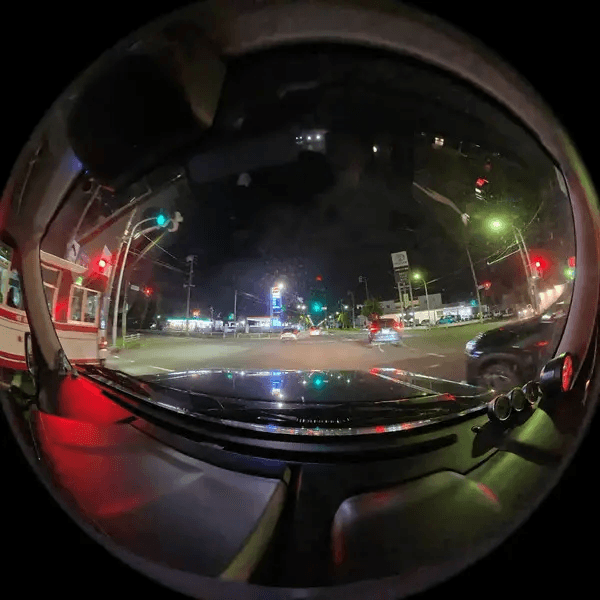
Only after converting to flat do you get the familiar, watchable angle.
That's the point of the X6's InstaFrame 2.0 with unlimited smart tracking: one tap locks on, then it auto-follows and pans smoothly, outputting 4K flat video straight out of camera — no reframing in post. You save editing time, you save SD card space, and in-app clipping gets easier. All upside.
Gimbal Control
There's a second layer: a "digital joystick" appears on screen, letting you pan the frame direction manually.
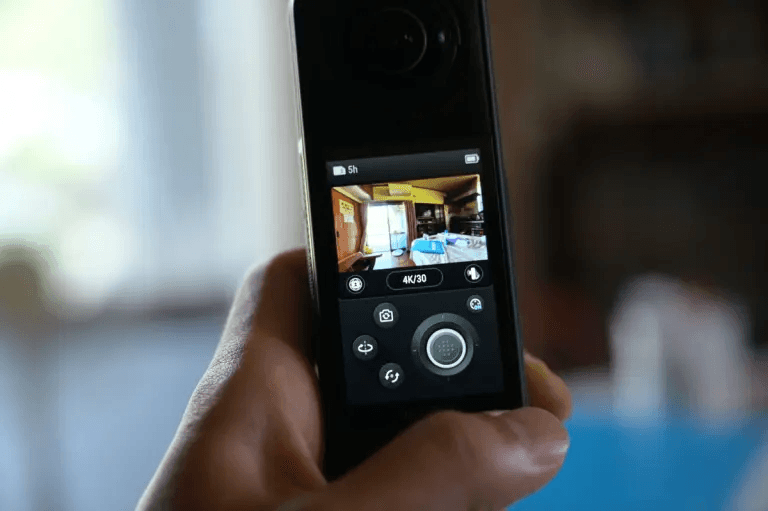
You can also just swipe on the screen. This works a lot like the joystick on the Flow 2 Pro phone gimbal — and paired with the foldable pocket selfie stick, the X6 effectively replaces a Flow 2 Pro. Pocket-sized; unfold it and you have camera + gimbal in one hand.
170° Ultra-Wide Angle
Both cameras max out at 170° in flat mode, but actual vlog framing differs: the X6 runs a bit narrower, the X5 wider. Likely the new lens design — to keep edge distortion cleaner, the algorithm crops a touch more frame. Even ultra-wide mode is slightly narrower on the X6.
In real vlog shooting, though, the X6's distortion-corrected angle lands close to the standard lens (roughly 20mm equivalent) on a gimbal camera like the Luna Ultra — which makes it even better as a main vlog camera: more natural subject framing, less stretch at the edges. In wide and ultra-wide modes the two cameras are effectively identical.
User Experience Differences
Startup Speed
The X5 already started fast; the X6 is faster still — press the button and it's recording, no wait. Pick it up after setting it down and it's awake in a second. The X3's "7-second startup" era is long gone; in daily use you won't feel a difference between X5 and X6.
| X6 | X5 | X4 | |
|---|---|---|---|
| Startup Speed Difference | 0 sec | 1 sec | 3.5 sec |
Handheld Recording
The shorter X6 is actually easier and more comfortable to hold than the X5. The design possibly takes a cue from the DJI Osmo 360 — most people who buy a 360 camera shoot on a selfie stick, so a shorter, lighter body is what users actually need.
Battery, Endurance & Heat
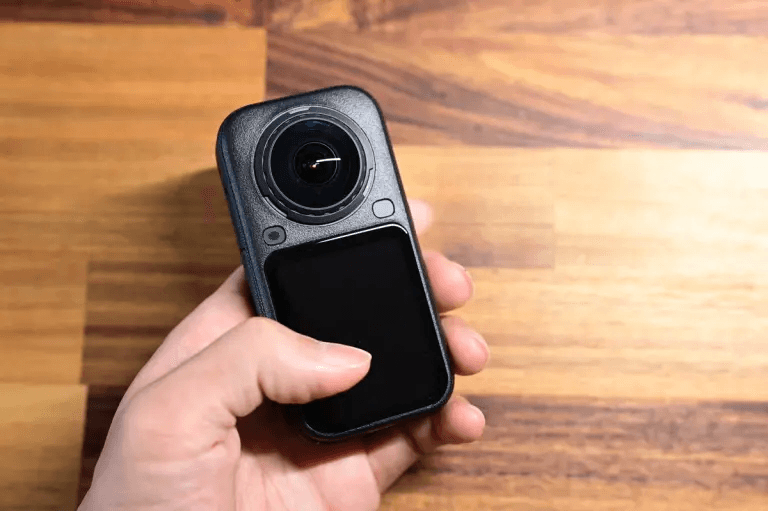
This is the section motorcyclists and long-session shooters should read twice. While shrinking the body, Insta360 still grew the battery — 2600mAh vs 2400mAh — and official recording time is up 51% over the X5. In plain terms: the X6's battery lasts 1.5× as long.
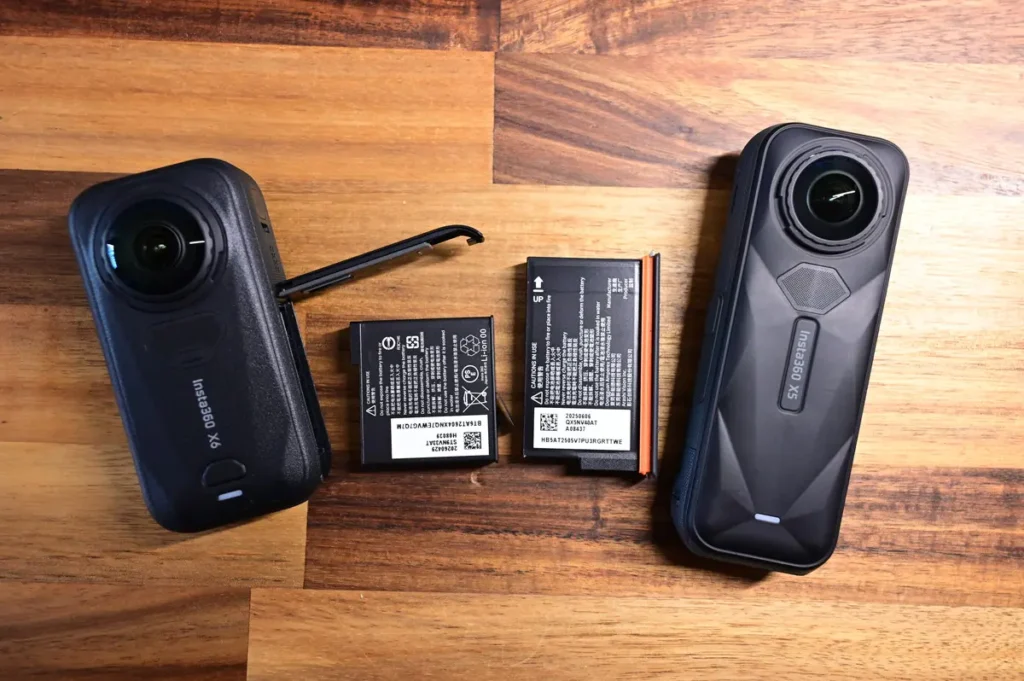
Counting back to the X3, the X6's recording time is already 2.5×. In my own timed test at 8K30fps, the X6 lasted 1.8× as long as the X5 — even better than the official figure.
| X6 | X5 | X4 | |
|---|---|---|---|
| Battery Capacity | 2600mAh | 2400mAh | 2290mAh |
| 8K30fps (tested) | 2h 36m | 1h 25m | 1h 15m |
| 8K30fps (Endurance Mode) | 2h 50m | — | — |
An extra hour of 8K recording per charge. That number speaks for itself.
Then there's heat — the bigger story. Straight from my real-world test: in direct summer sun, at 8K30fps while charging, the X6 ran continuously for 8 hours without a thermal shutdown. It only stopped because the memory card filled up — the actual figure was 7 hours 52 minutes of footage.
The X5 handles heat reasonably well, but in summer it still overheats — charging while recording, it gives up after about an hour, which long-distance riders feel keenly. The X6 also adds fast charging: 80% in roughly 20 minutes.
| X6 | X5 | |
|---|---|---|
| Battery Capacity | 2600mAh | 2400mAh (2800mAh) |
| 8K30fps (tested) | 2h 36m | 1h 25m |
| Endurance Mode (6K/5.7K) | 185 min | (208 min) |
| Charge Speed (0–80%) | 20 min | — |
| Overheat (15°C) | No thermal stop | None |
| Overheat (30°C) | No thermal stop | 41 min |
| Charge While Recording | ∞ (no thermal stop even at 8K) | 2h 56m (thermal stop) |
| Total Weight | 196.5g | 200g |
Smart Audio
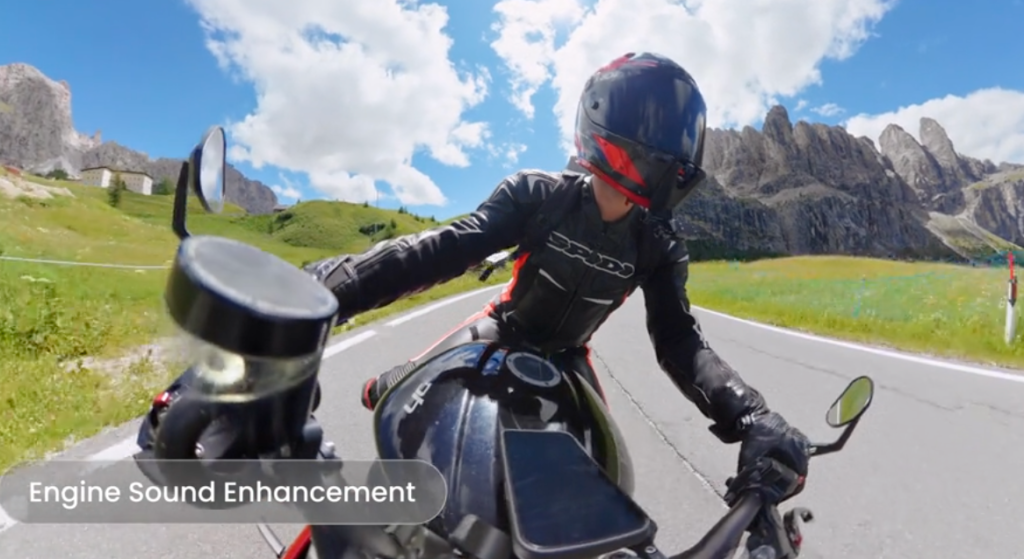
The X6 adds a genuinely useful "Smart Audio Mode" — it detects your shooting scene and picks the right audio setting automatically. Indoors talking, outdoors in sport: no manual noise-reduction or wind-cut fiddling; pro-grade audio is handled for you. For motorcycle riders it's perfect — wind noise gets cut, engine note stays in, and that sense of presence is fantastic.
Worth repeating: this mode is X6-only.
Waterproof Rating Difference
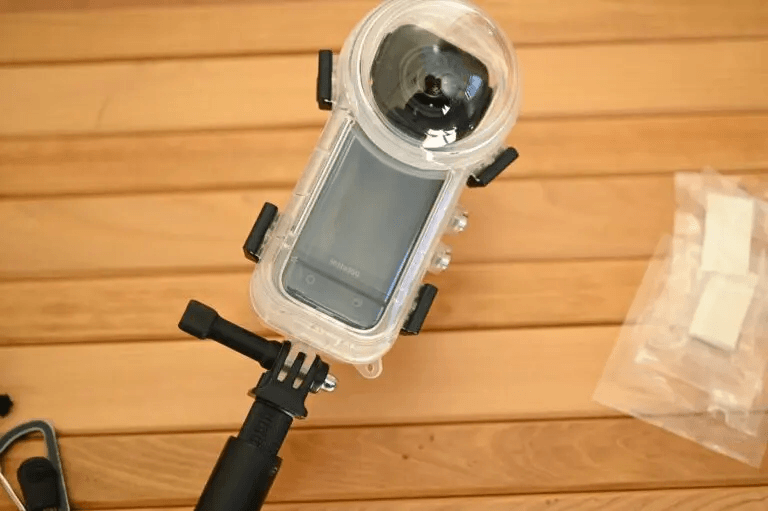
Bare-body waterproofing goes from 15m to 20m. But let's be honest: drop a 360 camera in water without a case and the refraction between the two lenses wrecks the image — for real diving you'd use Insta360's dedicated dive case anyway. So 20m vs 15m barely matters in practice.
| X6 | X5 | X4 | |
|---|---|---|---|
| Waterproof Depth | 20m | 15m | 10m |
With the Invisible Dive Case, both the X5 and X6 reach 60m (197ft).
X5 & X6 Similarities
Both apps are great
X6 or X5, the Insta360 app is light and easy to use — and that improves with app updates, so both cameras benefit equally. The app is smoother now than when the X5 launched, so the X5 experience has actually gotten better with age.
Basic operation
Day-to-day usage is identical. The invisible selfie stick just works, editing is simple, and shooting feels seamless on both.
| Item | Insta360 X5 | Insta360 X6 |
|---|---|---|
| Release Info | ||
| Release Date | 2025.04.22 | 2026.08.12 |
| Price | NTD$14,900 / HKD$3,699 | NTD$21,700 / HKD$5,099 |
| Core Hardware | ||
| Sensor Size | Dual 1/1.28" CMOS, F1.9 aperture | Dual 1/1.1" CMOS, F2.0 aperture ↑Upgrade |
| Image Processor | 2 pro image chips | 2 pro image chips |
| AI Chip | 5nm AI chip | 4nm AI chip ↑Upgrade |
| Screen | 2.5" LCD | 2.32" OLED |
| Dimensions | 46.0×124.5×38.18 mm | 50.0×100.0×40.0 mm |
| Weight | 206g | 196g ↑Upgrade |
| Battery Life | Removable, fast-charge 2400mAh 8K30fps 93 min |
Removable, fast-charge 2600mAh 8K30fps 140 min ↑Upgrade |
| Lens Guard | Interchangeable lens guard | Interchangeable lens guard |
| Built-in Storage | Not supported | 47GB ↑Upgrade |
| Shooting Specs | ||
| Photo Resolution | ~72MP (11904×5952) ~18MP (5888×2944) |
~120MP (15520×7760) ~42MP (6528×6528) ↑Upgrade |
| Exposure Compensation | ±4EV | ±4EV |
| ISO Range | 100-6400 | 100-6400 |
| Shutter Speed | Photo: 1/8000-120s Video: 1/8000 - frame rate limit |
Photo: 1/8000-120s Video: 1/8000 - frame rate limit |
| White Balance | 2000K-10000K | 2000K-10000K |
| Video Recording | 8K30fps 360 8K30fps night mode 5.7K60fps 360° motion HDR 4K60fps single-lens |
8K50fps 360, 14.5 stops dynamic range 8K30fps night mode 5K60fps 170° ultra-wide flat 4K30fps gimbal mode 2.0 ↑Upgrade |
| Video Format | Single-lens: MP4 / 360°: INSV | Single-lens: MP4 / 360°: INSV |
| Photo Format | INSP / DNG | INSP / DNG |
| Max Video Bitrate | 180Mbps | 240Mbps ↑Upgrade |
| Video Codec | H.264, H.265 | H.265 |
| Log Recording | Supported (8bit I-Log) | Supported (10bit I-Log) ↑Upgrade |
| Night Video Mode | Supported | Supported |
| Dynamic Tracking | Supported | Supported |
| Invisible Selfie Stick | Supported | Supported |
| Built-in Mic Wind Guard | Supported | 360° omni windshield mic ↑Upgrade |
| Video Modes | Video (motion HDR), night video, dynamic tracking, timelapse, moving timelapse, bullet time, loop recording, dashcam mode | Video (motion HDR), night video, dynamic tracking, timelapse, moving timelapse, bullet time, loop recording, dashcam mode |
| Photo Modes | Photo (HDR), interval, starlapse, burst | Photo (HDR), interval, starlapse, burst |
| Color Presets | Standard, Vivid, Flat | Standard |
| Stabilization | FlowState + 360° leveling | FlowState + 360° leveling |
| Protection & Misc | ||
| Cloud Service | Insta360+ cloud | Insta360+ cloud |
| Waterproof | Bare 15m, dive case 60m | Bare 20m, dive case 60m ↑Upgrade |
| Operating Temp | -20°C to 40°C | -20°C to 40°C |
| Audio Modes | Smart wind reduction (2 levels), voice boost, stereo, 360 audio | Smart wind reduction-strong, voice boost, stereo, 360 audio, engine sound boost ↑Upgrade |
| Audio Format | 48 kHz, 16-bit, AAC | 48 kHz, 16-bit, AAC |
FAQ
What's the difference between the X6 and X5?
Sensor: the X6 gets a custom SONY 1/1.1" sensor — roughly 4× the light intake of the X5, which is where the dramatic low-light improvement comes from.
Video specs: 360° recording goes from 8K30fps to 8K50fps — smoother footage. Plus 10-bit and Dolby Vision support for richer gradation and more grading headroom.
Photos: 360° photo resolution jumps to 120MP, and the aperture moves from F1.9 to F2.0.
POV tracking: the X6 adds POV auto-tracking, so the camera works as a daily vlog cam without manual angle control.
Battery: 2600mAh on the X6; 8K30fps endurance rises from 85 to 140 minutes, with PD fast charging hitting 80% in about 20 minutes.
What AI features does the X6 have?
AI Director
While the camera charges, it analyzes everything you shot that day in the background and auto-edits a complete highlight reel. Spend the day out, plug in at night, wake up to a finished video.
AI Edit Boost
The X6's AI recognizes 30+ scenes, auto-captures highlight moments and the best angles, and cuts a short clip in one tap — music and transitions included.
Cloud Compute Service
Beyond on-camera processing, the X6's "Moment Pro" uses cloud compute to auto-edit from a pile of footage — your phone never breaks a sweat.
Do I need to buy an accessory for X6 POV recording?
Yes — the gaze-following POV effect requires the POV Tracker accessory. It's an X6-exclusive feature the X5 doesn't have at all.
Is the X6 vs X5 waterproof difference big?
On paper, 20m vs 15m. In practice, almost nothing — bare-body underwater shooting suffers from refraction at the lens seam anyway, so both cameras really need the dive case for actual diving. With the case, both reach 60m.
Who should get the X6 vs X5?
For those with budget who want top specs
Users who value performance and shoot vlogs for long stretches
- Comfortable budget, unbothered by the high price
- Care about night shots and image quality
- Want POV tracking for vlogs
- Often record for long sessions (motorcycle trips / long rides)
For those on a budget entering 360°
Users fine with "good enough" image quality who don't want to upgrade
- Limited budget, want value for money
- "Good enough" image-quality needs
- Already own an X5 and don't want to upgrade
- Just want to start with 360° shooting
Conclusion: The 2026 Ceiling for 360° Cameras
Having shot with the X3, X4, X5, and now the X6, the conclusion is clean: the Insta360 X6 is the ceiling for 360° cameras in 2026. This isn't a routine "new chip, bumped spec" refresh — it raises every ceiling 360 cameras have been criticized for, all at once.
On image quality, the 1/1.1" SONY sensor and 120MP photos give the X6 depth and low-light purity that edge into digital-camera territory. On battery and heat, 8K recording while charging for nearly 8 hours without a thermal shutdown kills the old pain point for riders and long-session shooters outright. And the most important step — exclusive POV tracking — makes a 360 camera something you can genuinely run a daily vlog on, for the first time.
Choosing a 360 camera used to mean accepting trade-offs: a bit less image quality, more editing hassle, shorter battery. The X6 erases nearly all of them. It's expensive — and the expense is accounted for. In 2026, if you want a 360° action camera with no compromises, there's no second answer.
Insta360 X6
Insta360's new-generation 360° action camera — dual large sensors, top-tier stabilization, 8K image quality, and a premium experience that redefines the performance ceiling of 360° shooting.
None of this makes the X5 a bad camera. It's still above average for the category, and its price just got sweeter — the X6 is the ceiling, the X5 is the sweet spot. Want the absolute best? X6. Want into the 360° world at the best price? The X5 is still worth it.
Buy Insta360 Cameras Through Our Exclusive Link
and Get Free Accessories 🎁
The X6 and the new Luna Ultra are currently available with limited-time offers. Purchase directly from the official Insta360 store and enjoy fast shipping, so you can start shooting as soon as your camera arrives.
How to Use the Insta360 Discount Code
Click below to copy your exclusive Insta360 discount code:
Promotions, free gifts, and discount eligibility may change without notice. Please confirm that the offer has been successfully applied before completing checkout.